About Mhttps://sites.google.com/view/metamorphoses-alan-mitchell/metamorphoses-alan-mitchelle

This blog was started during a half-year sabbatical from full-time art teaching at St. John's International School in 2013 to develop my painting within the context of a Masters programme, charting my developing work in progress and related interests. Since retiring from full-time art teaching in 2025 I plan to continue to make posts that chart a developing meditative practice in art and life. If you click the link in my profile you can view more work on my website.

Sunday, August 21, 2016

Deconstructing 'self ' - Sophie Calle and the art of celebrating birthdays


Sophie Calle, The Birthday Ceremony, 1986, showcase containing various personal objects, 
Following a workshop exercise last week in school in which we were required to place a miscellany of four small things in an anonymous brown paper bag to represent our 'selves' to the others in the group who had to guess to whom they belonged, it struck me just how contingent on changing situations and contexts our perceived identity is in any given time and place, not a fixed or permanent essence that can be easily pinned down or reduced to one or another thing.  

How much it is individually and socially negotiated; constructed out of expectations projected by others onto the roles we are given to play as much as our own preconceptions and the qualities we bring to bear at the significant moments we are called on or feel the need to define 'ourselves'.    

Clearly we experience physical, emotional and mental changes internally and externally in the life cycle of our own bodies and the environment as they grow and age - nothing stays the same for long. We inherit so much from the actions and intentions of others before we were born and nature and nurture shape us long before we take ownership consciously of our own conditioning actions. 

All of this reminded me of Sophie Calle's 'The Birthday Ceremony' collections of gifted objects showcased in glass cabinets or her 'L'Hotel' series in which she assumes the role of a voyeuristic hotel maid who constructs the identities of the temporary occupants of the rooms she is cleaning, like a detective, from the physical evidence they leave behind. Concept, performance, installation, photography and text all play significant roles in the way she curates and presents the relationships between the public and private domains of the viewer and the viewed, framing the way we see and perceive the artificial 'realities' she constructs.  

Hotel room 47, 1981, Sophie Calle


Wednesday, August 17, 2016

Italy, Flanders and the poetry of decay

 
Studio Bibliografico Benacense, Riva del Garda http://www.studiobenacense.it/


Back from Italy after a short holiday with 'A' and already preparing for another hopefully creatively fulfilling academic year in Waterloo, Brussels and Bruges. When Pieter Bruegel the Elder traveled to Italy for the first time in 1552 crossing the French Alps on his outward journey and returning via the Tyrol and Switzerland in 1553 he made drawings of a landscape that was the diametrically the opposite to the Low Countries from which he had come. One can imagine how much more profound this experience would have been when the journey must have taken many months on horseback rather than just a day in the car. Time and space are relative and conditional experiential realities. Breathing and walking in the mountains, with their massive seemingly architectonic rock faces, challenges body and mind to find an equilibrium relative to what is large and open rather than small and enclosed in scale and proportion.  
Pieter Bruegel. Alpine Landscape

Dolomiti di Brenta above Molveno, August 2016
Apart from the pleasures of swimming, eating, walking and browsing old books (I managed to see and handle a lovely early printed edition of Ovid's Metamorphoses from 1551 at Studio Bibliografico Benacense, illustrated with small woodcuts like the one below) -
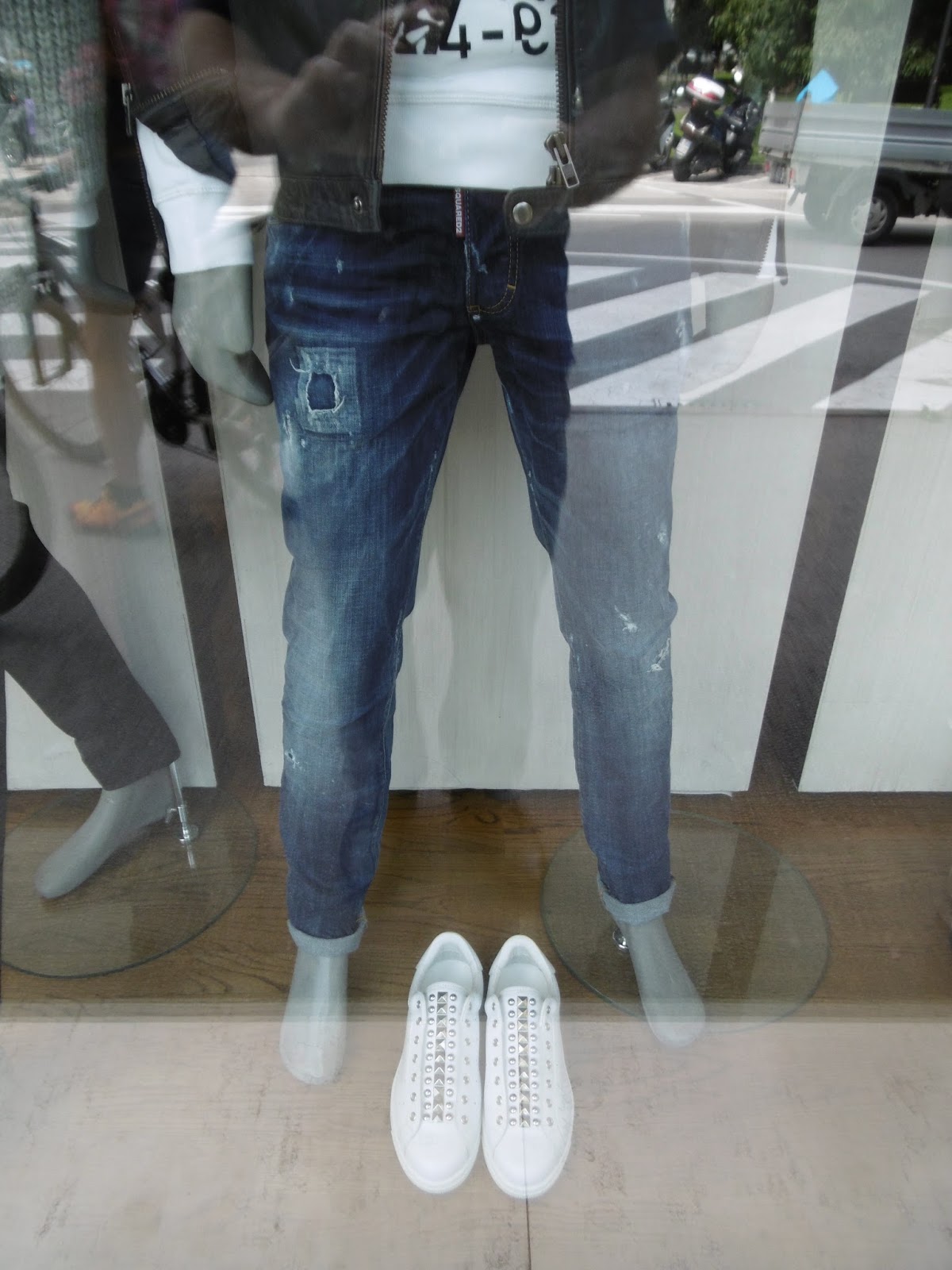
- Italy seemed to me to generate a veritable industry out of the 'poetry of decay. Antique broken statues and 21st century torn and patched jeans have all the impractical fashionable desirability of the romantic ruins that fascinated 18th century grand-'er' tourists than us, the mass consumers of a pre-packaged globalized travel industry. Surely this inversion of value adds a layer of irony to the seemingly irrational logic of markets that seek to exploit the luxury of designer poverty. Such ironies are not perhaps new.  The elevation of the impoverished and decayed to high status and value has had many patrons in Italian history not least amongst them St. Francis of Assisi who certainly created a poetry, both religious and aesthetic, from renunciation.


One's man's rubbish is another mans treasure.  

My own effort at attempting to create a visual poetry of decay, with trompe l' oeils oil paintings of torn paper and broken and damaged photographs, confirms that inner and outer worlds of experience are somehow aligned. 

Fugitive 4, oil on wood, 40x30cm
Italy also provided me with endless examples of the practical and visual qualities of lime mortar. The Roman Villa and Museum at Desenzano had both well preserved floor mosaics and a nice explanation of the various layers of lime mortar used to plaster its excavated walls


My own efforts with lime both inside and outside this summer have progressed to the point where most of the walls have been dubbed out and leveled with a first and second coat using the rough sand and lime mix and many have also had their final smooth layer with fine sand and lime mix floated up to a surface ready for a lime paint

I spent a week of physically backbreaking work digging out the living room floor down 30 cm ready for the breathable membrane, expanded clay balls and lime-slab which P and I plan to put in place ready for me to lay the natural blue stone tiles which are currently stacked under the stairs. I made a nice polish with pure beeswax mixed with turpentine from candles that came from a monastery we visited in the Meteora in Greece a few years ago and tested it on the surface with pleasing results. I will use this traditional mixture on the natural stone floor in the living room and the brick floor in the hall when it finally gets cleaned and polished. I found a quantity of larger 'moefen' and other broken bricks which are from the middle ages and later at the level of the foundations all of which have been saved to use in the open inner court space when I make another external brick pavement similar to the one in the hall laid in sand with a little lime mortar, but first we need to fix the French drain, rainwater collection tank and create a removable leveling cover for the septic tank. 


"Zoels in Ter Doest was zij opgetrokken in een groot formaat baksteen, 'moefen' genaamd. De kustreek bezit geen naturrsteen en blijkbaar hebben de cistercienzers aan het einde van de 12e eeuw in dit gebied de oude Romeinse techniek van het bakken van stenen opnieuw  in zwang gebracht," 

 Gids voor de kunst in Belgie.  J Kuypers, Prisma  1964 

Stone tiles stacked in hall


Beeswax polish on blue-stone tile under the red teapot

Outside I finished rendering the new kitchen and bathroom wall with a plinth to protect and visually unify the base and finished pointing and where necessary rendering the old wall opposite the kitchen window with a rough coat lime. Finally I was able to find exactly the right type of stone niche from a shop in Brussels on the rue Haute to provide a point of focus for this wall, connecting inside and out and aligning vertically and horizontally to the space. The stone niche originated as a small window in Rajasthan - the metal loops for a wooden shutter are still fixed in place. I find it brings a certain exotic theatricality, not out of place in gothic Bruges,  to the patterns and rhythms of the softened brickwork and animates the space with the flickering light of a candle, like an small external fireplace, contrasting and accentuating the natural colours of the sky and wall in the fading daylight.

Reading again the Dutch cultural critic Johan Huizinga's 'The Waining of the Middle Ages' in a battered old paperback edition I appreciated his ability to invoke and empathize with the experience of the pre-Modern mind. Certain insights resonate when they appear to be almost tangible realities.

 "But one sound always rose above the clamor of busy life and, no matter how much of a tintinnabulation, was never confused and, for a moment lifted everything into an ordered sphere: that of the bells."


Sunday, July 10, 2016

Material Agency.


16th century brick poised for action in spotlight of sunshine
Have spent the first part of my holiday rebuilding the terrace wall with largely reclaimed 16th century bricks. These warm red-ochre hand-molded terracotta forms, with the look and feel of loaves of bread, seem to find their place in the gaping 'wound' of the damaged wall through their own material agency, nudging into each other and bedding down with lime mortar to heal the damage caused through the removal of the outside toilet and store-rooms. The skin of the wall has a surface of patterns and rhythms as structurally logical and aesthetically balanced as the internal dynamism of a musical score or literary composition. It bears all the scars of fire, water, violence, damage, time and decay with almost the same vulnerability and sensitivity as human flesh as well perhaps as the marks or repair and regeneration.  


When the whole wall is re-pointed and given a traditional lime painted finish it will form a large and visible presence, in the only 'outside' room inside the house. Viewed from the kitchen or living room windows it defines the unlimited space of sky in its finite frame through the changing play of light, form, texture, pattern, and colour across its surface where one can read human and material agency across time and space. Perhaps it will also form the wall for a climbing rose in a small enclosed kitchen herb garden or 'hortus conclusus'.

'The current engagement with matter in art and cultural history is however more far reaching and fundamental...... It has come about in part through a dissatisfaction with the oddly disembodied sign or image of recent art history, but it is also linked to a much larger cultural interest in things, which may in turn be spurred partly by the increasingly disembodied nature of information and images in the digital age. Against globalized networks of data, a focus on the importance of the handmade and specific object can be seen like an act of resistance, even a form of grace'  

This above quote comes from the introduction to 'The Matter of Art. Materials, practices, cultural logics c 1250-1750,' edited by Christy Anderson, Anne Dunlop and Pamela H. Smith and published by Manchester University Press. Reading the essays inside by various contributors reinforces the conviction that experiential knowledge and understanding can transcend abstract thought and language, something artists know intuitively by making things out of material processes and academics learn through theory rather than practice. Meaning emerges though the creative interaction and relationships between many agents, 'animate' and 'inanimate' including the materials, the process and the context as much if not more than any prior concept or idea 'imposed' on them by an individual. For some kind of enriched creativity to happen the right conditions, internally and externally, need to be present, recognized and actively cultivated. Cause and effect are not linear here but complex and perhaps ultimately mysterious, beyond the grasp of logical reasoning alone. 

Meaning in the context of the wall of a house as an active agent is inseparable from the sense of 'dwelling' in a mind/body in time and space.  

 In their essay 'Non-Human Agencies: Trees in Place and Time' by Owain Jones and Paul Cloke the writers quote Ingold's discussion of Breugel's painting 'The Harvesters' (below) to illustrate their assertions about the nature of non-human agents in creating a sense of place or 'dwelling'. 

1565 The Harvesters, Pieter Breughel the Elder. oil on panel.

.......In other words, dwelling is a complex performative achievement of heterogeneous actors in relational spatial/temporal settings.  Ingold (1993) illustrates these ideas in a discussion of Bruegel’s painting, 'The  Harvesters'.  In this picture, an old pear tree takes centre stage as farm labourer rest and eat in its shade in between harvesting a field of grain; behind these is a view of a valley and a distant village and landscape. Ingold says of the tree by its presence it constitutes a particular place. The place was not there before the tree, but came into being with it. [N]o other tree has quite the same configuration of branches, diverging, bending and twisting in exactly the same way. In its present form, the tree embodies the entire history of its development from the moment it first took root. And the history consists in the unfolding relations with manifold components of its environment, including the people who have nurtured it, tilled the soil around it, pruned its branches, picked its fruit, and – as at present – use it as something to lean against. The people, in other words, are as much bound up in the life of the tree, as is the tree in the life of the people (pp. 167–8).

Carl Knappett l Lambros Malafouris Editors Material Agency Towards a Non-Anthropocentric Approach. 2008 PDF file

Wednesday, May 25, 2016

'Fleshing' the skeleton

Have been continuing as an 'artist in residence' to work on this painting in the classroom. Perhaps the best way to teach art is to model the creative process itself for the students, turning the classroom into an atelier. Finding the balance and relationship between drawing, which itself is a kind of skeletal structure, and oil paint, the more colourful 'flesh' or 'skin' of the picture, is what this works seems to be about.


As a work I can share the challenges and frustrations or reworking the paint surface with charcoal drawing and oil paint after a period of relative neglect when the picture was lying dormant and the idea was gestating and maturing underground like a plant over winter.

It strikes me that much of the work of an artist is invisible, taking place unseen and hidden, in ways that are mysterious  even perhaps to the artist himself. It is difficult to 'account' for this process, especially when I may have 20 odd unfinished works waiting to be rekindled at an opportune moment when they may or may not reach some kind of resolution. A bit like the orchid in my bathroom which has stood on the shelf being happily inactive for many years and which has suddenly sprouted a string of flowers for no apparent reason.


Whilst the spinal column and ribcage are some of the most beautiful forms in nature and the hidden structure that supports the musculature of the back is the aid to our most powerful and graceful movements, to many people a skeleton is either a morbid or sinister subject matter, despite its rhythmic abstract qualities and the focus it can provide as a scaffold for drawing both the shapes and relationships between positive forms and the negative space between them.

Both familiar and strange at the same time, our skeleton, like our body, the locus of both attraction and loathing, pain and pleasure, is the our only way of knowing the world, and is a source of endless wonder and fascination.  
As one of subjects of meditation in the Satipatthana Sutta in the section on the body, the nine cemetery contemplations, are encouragements to contemplate the true nature of material form as it goes through the process of decay and decomposition, as an aid to realization.

 "A body dead one, two or three day." This is the first contemplation.

"Whilst it is being eaten by crows." This portion of the Discourse where the devouring of the body of various kinds of animals is stated refers to the second contemplation.
"A skeleton together with (some) flesh and blood held in by the tendons." This is the third contemplation.

"A blood-smeared skeleton without flesh but held in by the tendons." This is the fourth.

 "A skeleton held in by the tendons but without flesh and not besmeared with blood." This is the fifth.

"Bones gone loose, scattered in all directions." This is the sixth.

 "Bones white in color like a conch." This is the seventh.

 "Bones more than a year old heaped together." This is the eighth.

 "Bones gone rotten and become dust." This is the ninth.


Tuesday, May 24, 2016

The art of illusions


The Innocent Eye Test 1981, Mark Tansy.
 I am not a realist painter. In the nineteenth century, photography co-opted the traditional function of realist painters, which was to make faithful renditions of “reality.” Then the realist project was taken over by Modernist abstraction, as later evidenced in the title of Hans Hofmann’s book Search for the Real. Minimalism tried to eliminate the gap between the artwork and the real. After that, the project itself dematerialized. But the problem for representation is to find the other functions beside capturing the real.
In my work, I’m searching for pictorial functions that are based on the idea that the painted picture knows itself to be metaphorical, rhetorical, transformational, fictional. I’m not doing pictures of things that actually exist in the world. The narratives never actually occurred. In contrast to the assertion of one reality, my work investigates how different realities interact and abrade. And the understanding is that the abrasions start within the medium itself.
I think of the painted picture as an embodiment of the very problem that we face with the notion “reality.” The problem or question is, which reality? In a painted picture, is it the depicted reality, or the reality of the picture plane, or the multidimensional reality the artist and viewer exist in? That all three are involved points to the fact that pictures are inherently problematic. This problem is not one that can or ought to be eradicated by reductionist or purist solutions. We know that to successfully achieve the real is to destroy the medium; there is more to be achieved by using it than through its destruction. 

Mark Tansey, quoted in Mark Tansey: Visions and Revisions, by Arthur C. Dante
 
In the history of paintings of paintings, pictures that are 'self aware' so to speak, Velasquez' 'Las Meninas' is undoubtably the greatest piece of visual rhetoric concerned with the problematic multidimensional realities of pictorial illusion, time and space, and the relationships between artist, subject/s and viewer/s ever explored through the medium of paint on a flat surface. The painting seems to transcend the limits of its own frame by knowing and understanding them so well. When we study it carefully we see that the perceptual reality which the artist has constructed so convincingly is merely an illusion caught between the mirrored gazes of our own eyes and those of the artist and his subjects, a trick of light and shadows, a game of 'smoke and mirrors' and the alchemy of medium itself - paint.  

When we see the illusion for what it is we know that the pictorial 'reality' is only as deep as the surface of the paint, the context of the frame and gallery is another parallel reality, and our own moment of interaction with the picture, through a variety of digital reproductions acting as intermediaries, another parallel world colliding with these coordinates through time and space.

Things in their true nature and illusions are of the same basic substance ........... (Thich Nhat Hahn) 

In the Satipatthana Sutta in the section on 'mental objects', the five 'khandas' or aggregates which we confuse and grasp at as 'me' and 'mine' are compared to various illusions.  'rupa' or material form is compared to  foam;  'vedanna' or feeling to bubbles;  'sanna', cognition or perception, to a mirage; and 'sankara' or volitional formations, physical or psychological forces that fashion things, to a plantain tree with no heart wood, and finally 'vinanna' or consciousness to a magician's illusion. By seeing clearly into the nature of the arising and cessation of these various phenomena we can discern that they are impermanent and not-self, and that there is no lasting satisfaction in conditioned phenomena which are inherently unstable. 

When we consider that the constructed reality of the painting has long outlasted the artist, his subjects and most of the people who have viewed it since 1656, we can appreciate the singular power of art as a focus for contemplation of both conditional and ultimate realities. 


Monday, May 16, 2016

Hortus Conclusus

To see the World in a Grain of Sand 
And a heaven in a Wild Flower,
Hold infinity in the palm of your hand
And Eternity in an hour. 

William Blake

In the Begijnhof in Bruges every high gable end window overlooking rooftops and chimney stacks or low door opening to a walled courtyard or hidden garden suggests the satisfactions of a deliberately chosen interior life of solitary seclusion, and the disciplines of work and contemplation, amongst a community of like minded individuals, gathered around the paradox of space at the centre of things, at once limited and confined yet infinite and liberating. 


In Rob Aben and Saskia de Wit's 'The Enclosed Garden, History and Development of the Hortus Conclusus and its Reintroduction into the Present-day Urban Landscape', the theme of orientation and alignment of body to cosmos and inner to outer space through the architecture of the enclosed garden, often at the heart of the city, monastery, large or small house, is developed as they describe the evolution of its design from the Middle Ages in both Christian and Islamic traditions with analysis of specific examples up to and including the present day. 

' In the enclosed garden there are palpable references enabling one to orient oneself in time, space and society. 'Cosmic orientation', the primitive experience of being on this earth, is provided by the opposition between earth and heaven, high and low, vertical and horizontal, light and dark. the sun's path and that of the stars aid orientation and give and sense of direction. 'Temporal orientation' is gained from the rhythm of the seasons, of day and night and their utterly different effect on our experience of space, and from the tangible presence of the past. 'Territorial orientation' proceeds from the visible topography, the simultaneous presence from close to far off, the references to the far distance from out of the enclosed space, and the dualities of centre and periphery and inside and outside. These various aspects of orientation take on architectural shape in the physical enclosure, a structure introduced into unspecified natural space: organizing the surface on the one hand and giving spatial form on the other.'

Elsewhere in relation to literary archetypes for heavenly paradises in either a garden or a city they indicate that the Dutch word 'tuin' (garden) and the English word town are related etymologically.  I would suggest this grounds Luc Schuiten's utopian vision of the 'vegetal city' in a much older tradition. 


In Keith D Lilley's 'City and Cosmos' the Holy Blood procession in Bruges, (which took place last Thursday 5th of May) performs a per-ambulatory geography of the Holy Blood that is (according to Boogaart)

'...symbolically and cosmologically significant, tracing an outline of the world in and through the city, taking in the whole city and encompassing it with the holy blood of Christ the Redeemer.'

'There is therefore a social and spatial parallelism in the ordering of city and cosmos as traced out by the geography of the Bruges procession. The procession began at the city's spiritual and symbolic centre, its axis mundi, the place the city's ruling 'head' resided. Then with its movement from the centre to the edge, from inside to outside the city, and in encompassing its perimeter, the procession traced out the moral topography of the cosmic body, with its 'purer' inner core contrasting with its outer margins, the place of the lower orders. Hence through its shared forms and hierarchical ordering, unifying the city's body yet reinforcing its divine order in the social hierarchy, the procession of the Holy Blood drew onto the city a 'map' of the cosmos.'  


Bruges 'egg' shape suggests enclosure and containment, something warm, protective and nurturing, a place for incubating life.  


 In Gaston Bachelard's 'The Poetics of Space', physical and psychological worlds converge in the archetypal 'house', rather than garden or the city, where both body and cosmos, dreams and reality are comfortably accommodated. In the chapter, 'The house, from cellar to garret and the significance of the hut' he writes,

'For our house is our corner of the world. As has often been said, it is our first universe, a real cosmos in every sense of the word.'

'And always, in our daydreams, the house is a large cradle.'

'Life begins well, it begins enclosed, protected, all warm in the bosom of the house.' 

Quoting Anne Balif on page 72, in the chapter 'House and Universe', he writes,  

"...asking  a child to draw his house is asking him to reveal the deepest dream of shelter he has found for his happiness. If he is happy, he will succeed in drawing a snug, protected house which is well built in deeply rooted foundations". It will have the right shape, and nearly always there will be some indication of inner strength. In certain drawings, quite obviously, to quote Mme. Balif, " it is warm indoors, and there is a fire burning, such a big fire, in fact, that it can be seen coming out of the chimney." When the house is happy, soft smoke rises in gay rings above the roof. 

My own effort to dream up and create renovated fireplace is still a work in progress but the soft contours of NHL 3.5 hydraulic lime plaster give the consolidated walls a traditional, breathable surface that is both beautiful and consistent with the original lime mortar between the old bricks and under the stripped later layers. There is sanding and building to be done tiles and a top to be added to the mantle and surround and the floor has to come out and terracotta tiles have to be laid on a lime-crete slab and breathable insulation layer.


and of houses, bodies and the cosmos, time and space the Buddha had this to say......

  "I tell you, friend, that it is not possible by traveling to know or see or reach a far end of the cosmos where one does not take birth, age, die, pass away, or reappear. But at the same time, I tell you that there is no making an end of suffering & stress without reaching the end of the cosmos. Yet it is just within this fathom-long body, with its perception & intellect, that I declare that there is the cosmos, the origination of the cosmos, the cessation of the cosmos, and the path of practice leading to the cessation of the cosmos."

Rohitassa Sutta  AN 4.45 Trans. Thannissaro Bhikkhu

"Seeking but not finding the house builder,
I hurried through the round of many births:
Painful is birth ever and again.

O house builder, you have been seen;
You shall not build the house again.
Your rafters have been broken up,
Your ridgepole is demolished too.

My mind has now attained the unformed Nibbâna
And reached the end of every sort of craving."

Dhp.153 - 154. Trans. by Ñanamoli Thera