About Mhttps://sites.google.com/view/metamorphoses-alan-mitchell/metamorphoses-alan-mitchelle

This blog was started during a half-year sabbatical from full-time art teaching at St. John's International School in 2013 to develop my painting within the context of a Masters programme, charting my developing work in progress and related interests. Since retiring from full-time art teaching in 2025 I plan to continue to make posts that chart a developing meditative practice in art and life. If you click the link in my profile you can view more work on my website.

Tuesday, August 20, 2013

A Book of Changes

Below are the currently completed pages of an on-going 'artists book' project. I am working with brush and ink and to explore a cyclical relationship between the circle and the square and to contemplate the unity of opposite forces, light and dark, arising and cessation, form and emptiness, being and nothing, time and space, relative and absolute......... 

I am about half way through and not sure how it will continue to evolve except that I will keep to the format of circle and square and sequence of the pages from left to right until I reach the back of the book - and begin again ? 


Reflections on the painted surface


Applying the oil paint layer on top of the acrylic under-painting several things occur to me:

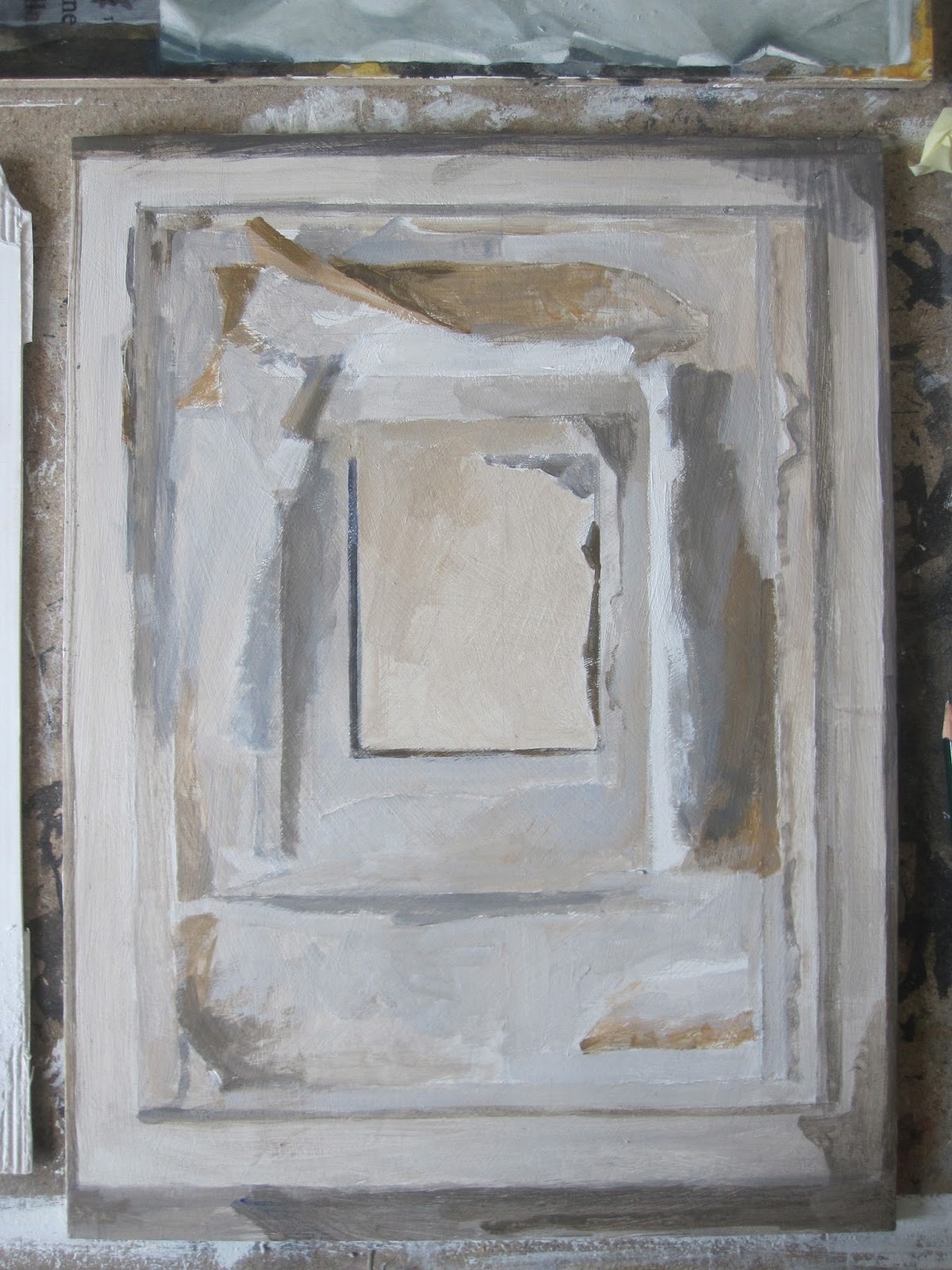
 The need to focus on the pure abstract compositional elements of the work (the relationship between the vertical, horizontal and diagonal lines, positive and negative shapes and spaces, and the patterns and rhythms of the forms) even while the 'image' is anchored in literal observation of an actual prepared collage and still functions as a trompe l' oeil.  
The importance of balancing colour and tone as key elements of the composition- to allow colours to 'resonate' by mixing complimentary chromatic greys and browns of various degree of saturation and intensity and calibrating tones  to the right degree - so that white is the lightest tone.  
The importance of not over painting - just allowing the fresh gestural marks to fall into place with an apparent 'naturalness' or spontaneity - to keep the gestural painterly qualities of the medium.  
The positive and negative shapes of the spaces that are framed and defined by the forms of torn or folded paper with  trompe  l 'oeil shadows ( like doors or windows ) are areas of 'emptiness'. In this 'emptiness'  the 'image' (or the image of the image') is both revealed and hidden simultaneously. This is in effect a picture of a non picture, a depiction of 'de-piction'  or an a painting of 'un-painting' ( to use a term borrowed from Francios Jullien ) - the act of painting is in a sense an 'assertion' of a 'negation'  
In a world of electronic image overload can the act of painting, (or active contemplation) ironically, perhaps be a way of 'earthing' this charge, of bringing it back 'down to earth' both literally and metaphorically, and of rendering the world of perceptual proliferation, of slick image production and of powerful visual illusion 'safe' again?


Friday, August 16, 2013

Breathing and Drawing


Drawing from the live moving model you become aware of how the drawn gestural mark begins, grows, fades and ends in a split second of observation as the model adopts new poses that evolve from previous ones. This process of looking and drawing becomes  'accumulative' and one starts to anticipate and predict the rise and fall of a movement before, during and after making the mark on the paper in sort of inverse cinematic way, turning the flow of movement back into fragmentary still images.  At first the mind resists this constant change, wanting the image to be still so it can capture the gesture of the model in the mark but strangely as you get used to the process of intense concentrated looking  and drawing the pencil begins to 'dance' and moves on the paper in synchronisation with the movement of the model,going, as it were, 'with the flow' letting go and accepting the constant changes as much as holding on to and trying to capture a frozen moment. 

This seems very like observing the breath in breathing meditation (anapanasati) - you cannot hold the breath in order to observe it but can watch it arise and fall naturally, each inhalation and exhalation conditioning the next in continuous cycles.

" First we contemplate just the breath until we see that it is impermanent. We observe that the breath changes and becomes long. Its long duration is impermanent, always changing, getting long and shorter. Its shortness is impermanent as well. The various conditions and characteristics of the breath are impermanent. "

Page 92 'Mindfulness of breathing' ( a manual for serious beginners) Buddhadasa  Bhikkhu 

I am drawing flowers from observation at the moment in various stages of growth and decay by working on top of and over earlier stages of observation and layers of drawing with various media. I am trying to explore how the drawing itself can 'breath' or 'respire' as the subject changes shape and moves in the various stages of its cycle and the forms and spaces alter and change. Not sure how to know when the drawing is finished but plan to work on several of these drawings as I explore this approach.   


I am also reading 'The Great Image Has No Form, or On the Nonobject through Painting¨ by Francois Jullien (translated by Jane Marie Todd) and am finding lots of suggested relationships in this text between drawing and painting in traditional Chinese painting as described by the author and insight from traditional Buddhist meditation although the writer quotes the Laozi and Zhuangzi as the great Taoist texts and philosophies that were informing many of the seminal Chinese landscape painters of the Sung dynasty. One of the key figures, the painter/poet Wang Wei, was a practising Buddhist. 

Here is an example to do with 'breath-resonance'

"Instead of categorically setting up presence and absence as opposites, expiration and inspiration govern each other and indefinitely allow passage. The disappearing -reappearing path in Chinese painting, far from serving to construct the painting's perpective by designating a vanishing line by virtue of which progressive and proportional diminution of objects would be rendered, serves rather to unfurl the landscape in continuous renewal" 

Page 11 'Presence-Absence ' 'The Great Image Has No Form, or On the Nonobject through Painting¨ by Francois Jullien (translated by Jane Marie Todd) 

       What is the relationship between the practising art and meditation, between Dhamma and Painting?  Perhaps it has to do with trying to actively understand how we perceive and construct 'realities' in worlds and images. 

Ajahn Amaro the current abbot of Amaravarti Buddhist Monastery in England says this or something very similar in a recent podcast. I apologise for any inaccuracies.  

"We don't experience the world, we experience our minds representation of the world which is not to say there is no real world."

and this from the Dhammapada translated by Juan Mascaro,

" What we are today comes from our thoughts of yesterday; and our present thoughts build our life of tomorrow; our life is the creation of the mind. "

The work in progress below in acrylic under-painting represents the stages so far of a new painting. The problem is how to keep the fresh, lightness of touch and the sketch-like painterly unfinished quality when the work is either finished or abandoned ?


Wednesday, August 14, 2013

Drawing and Modelling Art and Anatomy at the Ruskin


Programme Feedback

Review of the Art and Anatomy Course at the Ruskin School of Drawing and Fine Art.    University of Oxford.   4th-10th August 2013


The Ruskin School of Drawing and Fine art in Oxford provided a unique setting for this art and anatomy workshop.  Oxford's compactness meant it was easy to get to the important artistic and scientific collections at the Bodleian Library, Ashmolean Museum, Natural History and Pitt Rivers Museums and Botanical Gardens, etc; which were only a few minutes walk away and its great architectural heritage made an ideal setting to enrich the practical studio work and critical lectures and discussions.  
I was able to go to three ancient music concerts in the evening during the week and was stimulated by trips to Blackwell's Bookshop and walks in Christchurch meadows in the early morning summer sunshine. Oxford may sometimes seem like a small provincial English town but the whole world seemed to be there on every street corner and yet this global reach did not diminish its human scale.
The 17 students on the course represented a balance of ages and nationalities and all were serious and focused throughout in the friendly and sociable atmosphere set by the tutors and the generous supplies of tea, coffee, biscuits and cake provided by the Ruskin support staff. 
Some of the younger students were preparing for college applications but my own interest as a mature student was to reinvigorate a critical approach to drawing practice as part of a four month sabbatical designed to enrich my teaching of art at St. John's International School in Belgium and I was not disappointed.
We were taken through a series of formal lectures alternating with practical studio sessions, drawing and modeling directly from the skeleton and excellent live models in the studio. These activities gave an accumulative critical insight into the development  and culture of scientific and artistic anatomy and its images, placing them into both historical and contemporary contexts by reviewing key examples. Professors Brian Catling, Sarah Simblet and Eleanor Crook also generously shared examples their  work and expertise in slides and handouts and recommended reading lists as well as by bringing in actual examples of their own work. It was a great privilege to see the clarity of Sarah's jewel like botanical drawings for her books and her enormous early dreamlike anatomical drawings first hand. Indeed seeing this work and hearing Sarah talk about drawing opened up so many possibilities for understanding and practicing this great universal visual language.   
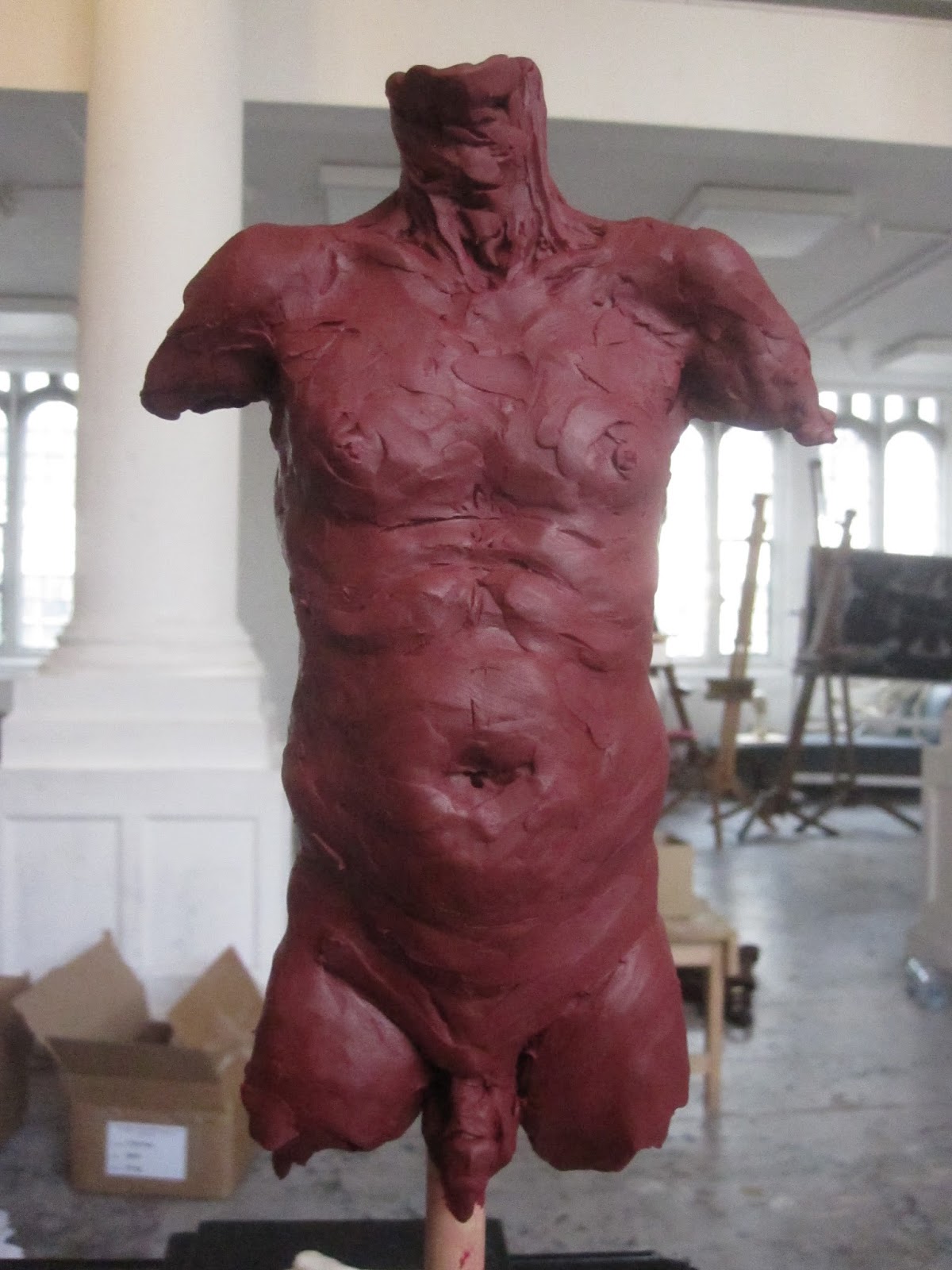
With both group and individual tutoring placing an emphasis on the process of looking and drawing throughout the pace was rigorous and challenging but the atmosphere was positive and enjoyable and we covered a large amount of material in only one week and everyone was productive - I made two wax models with facial and torso musculature and around 12 large drawings of the skeleton and human figure informed by Sarah and Eleanor's clear explanations of the human anatomy and critical reading of it in various contexts.
For me this course was about so much more than learning to draw the human body by studying bones and muscles, although it achieved this aim successfully in the limited time.  I found I was also stimulated and inspired to connect the topography of the human form in a pivotal way with a whole matrix of connected critical ideas and understandings of biology, geometry, language, architecture, geography, social, ethical and cultural history, religion, mythology, psychology, etc., that opened up a world of potential meanings and possible further investigation of cross-curricular connections that underline the importance of this subject - indeed without a human body/mind to experience it there is no world. 

All in all it was a wonderful and memorable experience that will continue to inform and enrich my own thinking, studio practice and teaching for some time to come and for this I am grateful.

Alan Mitchell
August 2013


Links to Ruskin School of Drawing and Fine Art and Tutors of the art and antomy course

http://www.ruskin-sch.ox.ac.uk/


http://www.amazon.com/Sarah-Simblet/e/B001KHAFL6


http://www.youtube.com/watch?v=bb8WfQU1338


http://www.eleanorcrook.com/


http://www.wellcomecollection.org/explore/science--art/video.aspx


http://briancatling.com/


Below is a selection of drawings and models I made during the course.


Travels in Italy and England

Back home and in the studio after travelling in Northern Italy with Alex and in Oxford for an Art and Anatomy course at the Ruskin School of Drawing and Fine Art.  Found several examples of folded paper fragments painted in trompe l' oeil in the collection of the Castelvecchio Museum of Verona.....


.....and this wonderful fragment of trompe l' oeil fresco in the church of St. Anastasia with the classical moulding of a door case painted to scale.  The flatness of the plastered wall clearly contradicts the illusion of depth and closes the suggestion of an opening into space. Where we expect the focus to be - in the space of the opening created by the frame - there is 'nothing'. The frame is the image, a seemingly three dimensional 'form' circumscribing 'flat' space. Is this a door leading nowhere or an illusion leading to a reality ? 


 Reading Don Quixote again after many years - surely this is the ultimate literary equivalent of the visual tromp l' oeil. 

Don Quixote's madness derives from his obsessive reading of chivalric stories and his gradual dis-engagement with his illusions when confronted with reality are all fictions and conceits from the creative imagination of the author, fictions inside a fiction, an inverted or indirect mirror of reality for the author and his reader to discover the inter-dependent nature of and relationship between reality and illusion, reason and madness, art and life. 


I found this article by Peter Dunn entitled "Don Quijote through the Looking-Glass"  that seems relevant  both to the act of looking / painting and reading / writing. It comes from   

http://www.h-net.org/~cervant/csa/articf82/dunn.htm

"Don Quijote through the Looking-Glass"

This convergence of the metaphors of mirror and book, of image and copy, may be particularly suggestive for our reading of Don Quijote.
     What is fascinating about the images that we see in mirrors, and in books, is that they condense into a small area objects that in reality occupy a lot of space, and still manage to look life-size. Mirrors can enclose within their small surface the limitless depth of space and sky, which is mystery enough; but they may also puzzle and surprise us with the sharpness of their images, and with their curious deviations from what is expected. Mirrors thereby presume an inner authority, which disconcerts us by contradicting what we feel sure we know. They make us see ourselves as other, because they do not conceal what we usually conceal from ourselves: Velázquez's “Rokeby Venus”, in front of her glass makes the point with her peculiar reflection. But in fact there is no authority that could be identified within the mirror. And the glass as metaphor can deceive, too; the mirror of art presents images structured according to the shapes desired by the perceiving mind. Velázquez's Venus sees herself as she wants us to see her. Mirror images, therefore, leave us with two uncomfortable paradoxes. The first is that two worlds can be made to occupy one space, the world of the mirror in the world that is being mirrored. The second is that one world can double itself into two spaces. But in art, these are not paradoxes, for in art two worlds can occupy a single space. 

Peter Dunn 

From: Cervantes: Bulletin of the Cervantes Society of America 12.1 (1992): 5-17.