About Mhttps://sites.google.com/view/metamorphoses-alan-mitchell/metamorphoses-alan-mitchelle

This blog was started during a half-year sabbatical from full-time art teaching at St. John's International School in 2013 to develop my painting within the context of a Masters programme, charting my developing work in progress and related interests. Since retiring from full-time art teaching in 2025 I plan to continue to make posts that chart a developing meditative practice in art and life. If you click the link in my profile you can view more work on my website.

Sunday, December 14, 2014

Living inside and outside of the box.......

In Gaston Bachelard's 'The Poetics of Space - the classic look at how we experience intimate places,' there is a chapter on 'drawers, chests and wardrobes'.  He makes a connection between the house and the box as a secret refuge for our imagination. 

Sometimes, a lovingly fashioned casket has interior perspectives that change constantly as a result of daydreams. We open it and discover that it is a dwelling-place, that a house is hidden in it. 

An anthology devoted to small boxes, such as chests and caskets, would constitute an important chapter in psychology. These complex pieces that a craftsman creates are very evident witnesses of the need for secrecy, of an intuitive sense of hiding places. 

The poet lives a daydream that is awake, but above all, his daydream remains in the world, facing worldly things. It gathers the universe together around and in an object.

Some months ago I bought, repaired, cleaned and restored an early 19th century Persian Khatamkari table chest which was damaged but still relatively solid and complete. Its micro-mosaic inlay clearly recalled in miniature the complex geometric tiled patterns in the floors and walls of Islamic architecture.


The relative scale, from the minute almost microscopic detail in the box held between the hand and eye and the intricate delicacy of light, colour and pattern experienced by the whole body in architectural dimensions clearly relates to space but also to time and the infinite effort and patience required to make this work.....

'The Tomb of Itimad-ud-Daulah, Agra. India,  from December 2013

In the introduction to his book 'Islamic Patterns, An Analytical and Cosmological Approach', Keith Critchlow's writes,

The nature of origins or the creation point of a subject is grounded in mystery. The nature of a point- the simple, self-evident origin of geometry -is one such mystery: is it possible that a point 'has no dimension', except that it be a metaphysical point, and how can it occupy 'place' if space has not yet been created from its unfolding ? Clearly there has to be a precise differentiation between physical and metaphysical, between idea and expression, yet both are embraced by one reality. 

It is difficult to say whether the box was more 'beautiful' before rather than after 'restoration'. The effects of time through decay and loss suffered by objects are often compelling beautiful when they are not disguised, revealing the reality of nature, or nature of reality in a direct and startling way.  


Cleaning and polishing surfaces to bring out the innate qualities of material and craftsmanship is a challenging  and ultimately deeply rewarding experience. 

This English laburnum oyster veneered chest from around 1700 took me around two weeks of hard work a few summers ago to carefully clean and consolidate the entire surface, which was in pretty good condition to begin with despite it's appearance, an unpleasant treacly colour with layers of dark opaque, cracked and flaky old shellac varnish. After cleaning it meticulously inch by inch I polished it with a home made recipe which included carnauba and beeswax.  The bright, translucent lustrous figure of the wood captures and reflects light in the depth of its surface. For me all the summers of the English Civil War and Restoration are trapped and preserved in the amber glow of the decorative tree rings or 'oysters' that form the overall surface pattern, a technique learnt from Dutch craftsmen.


The inlaid stringing pattern of interlocking spiralling and concentric circles on the top of the chest recalls the design on this Cosmati pavement which I photographed in the Duomo in Amalfi a couple of summers ago. 

Cosmati pavement St. Anthony's Cathedral, Amalfi, Italy.

In 'Patterns of Thought, The Hidden Meaning of the Great Pavement of Westminter Abbey', Richard Foster analyses this famous Cosmati pavement which follows the same pattern of spirals and circles saying in the final chapter , 'Into the Labyrinth', 
The three main elements of the design represent the three stages of both birth and the death of the universe. Like the three fold division of the inscription, these three design elements also signify three levels of time: the mundane scale of human activity, the astronomical scale of the world ages, and the timeless scale of eternity.

'Here is the perfectly rounded sphere which reveals the eternal pattern of the universe.'
Final phrase of the text from the inscription.  
James Turrell creates architectural spaces, boxes with windows that frame the changing relationships of colour and light perceived by the viewer between interior and exterior space 'on the cusp of change' through the passage of time.  These structures act like the aperture of a camera in a sense to focus our experience into a more intense meditative awareness of consciousness in the present moment in which open and closed, tangible and intangible, form and formlessness, finite and infinite are experienced as dissolving into each other through a symbiosis of nature and art. 

We could experience the changing conditions of light and dark, wet and dry, warm and cold living in a house/box with the same heightened awareness of inside and outside through the window framed view of space.  This is the changing view through the restored box room window of the house in Bruges. 


In this interview on youtube link below 'James Turrell: "Second Meeting" "Exclusive " Art2,  he explains his understanding in what seem like Buddhist terms. 


This world that we have around us is not a world that we perceive but more a world that we create and make - now this seems a bit of a surprise because we really feel and we are very much attached to the fact that we are receiving these perceptions as opposed to creating them - but we do create the reality in which we live. 

This corresponds to the first words of the Dhammapada in Chapter 1, Contrary Ways. 

What we are today comes from our thoughts of yesterday, and our present thoughts build our life of tomorrow: our life is the creation of our mind. 

If a man speaks or acts with an impure mind, suffering follows him as the wheel of the cart follows the beast that draws the cart

What we are today comes from our thoughts of yesterday, and our present thoughts build our life of tomorrow: our life is the creation of our mind. 

If a man speaks or acts with a pure mind, joy follows him as his own shadow. 


Monday, December 8, 2014

The Poetry of Thrift


I have finally discovered a use for the 1970s tongue and groove pine panelling I have been stripping off several walls. By carefully trimming the edges off I can fill the gap in a solid door frame I already have with the remaining stips. I want to salvage, recycle and repair as much as possible both from within the house itself and sourced from outside if necessary. This is more than just thrift where necessity of the proverbial mother of invention.  There is a certain aesthetic to the used, damaged and repaired where the passage of time and the process of reclamation is not disguised or hidden under layers of shiny new paint.  


My Cracked Wooden Bowl

This treasure was discovered in a bamboo thicket-
I washed the bowl in a spring and then mended it.
After morning meditation I take my gruel in it;
At night, it serves me soup or rice.
Cracked, worn weather beaten, and misshapen 
But still of noble stock !

from 'Dewdrops on a lotus leaf'  Zen Poems of Ryokan. Translated by John Stevens

The same principle applies throughout where I will retain as much as possible of the original fabric of the house and replace if necessary like with like when making an 'honest' repair which is not covered over or hidden.


On Sunday morning I made a trip to Schaeverbeke for bread and a visit to http://www.hosteart.com/ on the Nieuwe Gentweg where I was introduced by Caroline to the surrealist sculptures of Marcel Taton combining glass, bronze and unusual found objects (gleaned from flea markets in Belgium and Venice) in whimsical, humorous, ironic and incongruous clusters - another case of the discarded artfully metamorphised into new forms and meanings.  

 
Also bought tickets for two concerts at the Concertgebouw in 2015-Vox Luminis in January singing work by Purcell, Morley and Schutz and Emma Kirkby and Jacob Lindberg with 16th century 'Songs and Ayres' in March 

Monday, November 24, 2014

Wooden Bones

View of Sint Salvators from the repaired flat roof below. 

Now that the ceiling of the living room is finally stripped its resemblance to a spine and ribcage is more apparent than ever. I am still considering the aesthetics of whether or not to remove the old cladding around the central oak spine beam supporting the joists. There are still many hours of cleaning before treating the wood with beeswax.


Meanwhile I have scraped, sanded and primed the salvaged window of the Kleine Slaapkamer which should be good for a few years yet.

 I continue to reflect on the four elements and how they arise and cease, both inside and outside the body, the house, the city and in nature, the earth and space and how all of these are interconnected.

Re-reading Thoreau's account of how he lived at Walden Pond several   passages have a particular resonance for me 

'The gentle rain which waters my beans and keeps me in the house prevents my hoeing them, it is of far more worth than my hoeing. If it should continue so long as to cause the seeds to rot in the ground and destroy the potatoes in the low lands, it would still be good for the grass on the uplands and, being good for the grass, it would be good for me.' 

'I go and come with a strange liberty in Nature, a part of herself'


'Shall I not have intelligence with the earth? Am not I partly leaves and vegetable mould myself ?'

This last especially when I am brushing leaves in the terrace.................. 


Meanwhile I continue to work on a series of small colourful acrylic paintings on panels prepared with gesso using masking tape and layers of overlapping paint. these small studies are simple and playful experiments, variations on elemental shapes, light and colour and I am happy to work intuitively reading each movement and gesture as it arises in relation to the accumulated previous ones.   


The following 'collages' where revealed in the course of stripping the walls back to either plaster or masonry.  Their colours have the faded elegance of 18th century silk................. 


Tuesday, November 11, 2014

Of chimneys and gable ends...


'But a man has no more to do with the style of architecture of his house than a tortoise with that of its shell.......... 

...........What of architectural beauty I now see, I know has gradually grown from within outward, out of the necessities and character of the indweller, who is the only builder - out of some unconscious truthfulness, and nobleness, without ever a thought for the appearance and whatever additional beauty of this kind is destined to be produced will be preceded by the unconscious beauty of life. 

Henry Thoreau  'Walden' 
fragments of text discovered attached to the
underside of the joists and floorboards.  

The October break gave me a chance to really begin to strip back the layers of wallpaper, board, vinyl and plastics that seem to have stifled and suffocated the structure of the house over the years. It is strange but it feels rather like being inside a three dimensional version of one of my paintings, peeling back layers of time packed with dust and memories long since discarded and forgotten 

Emblemata 6.
Egg tempera, Indian ink acrylic and silver-point on wood 25x33cm. 
Partially stripped wall in the house.

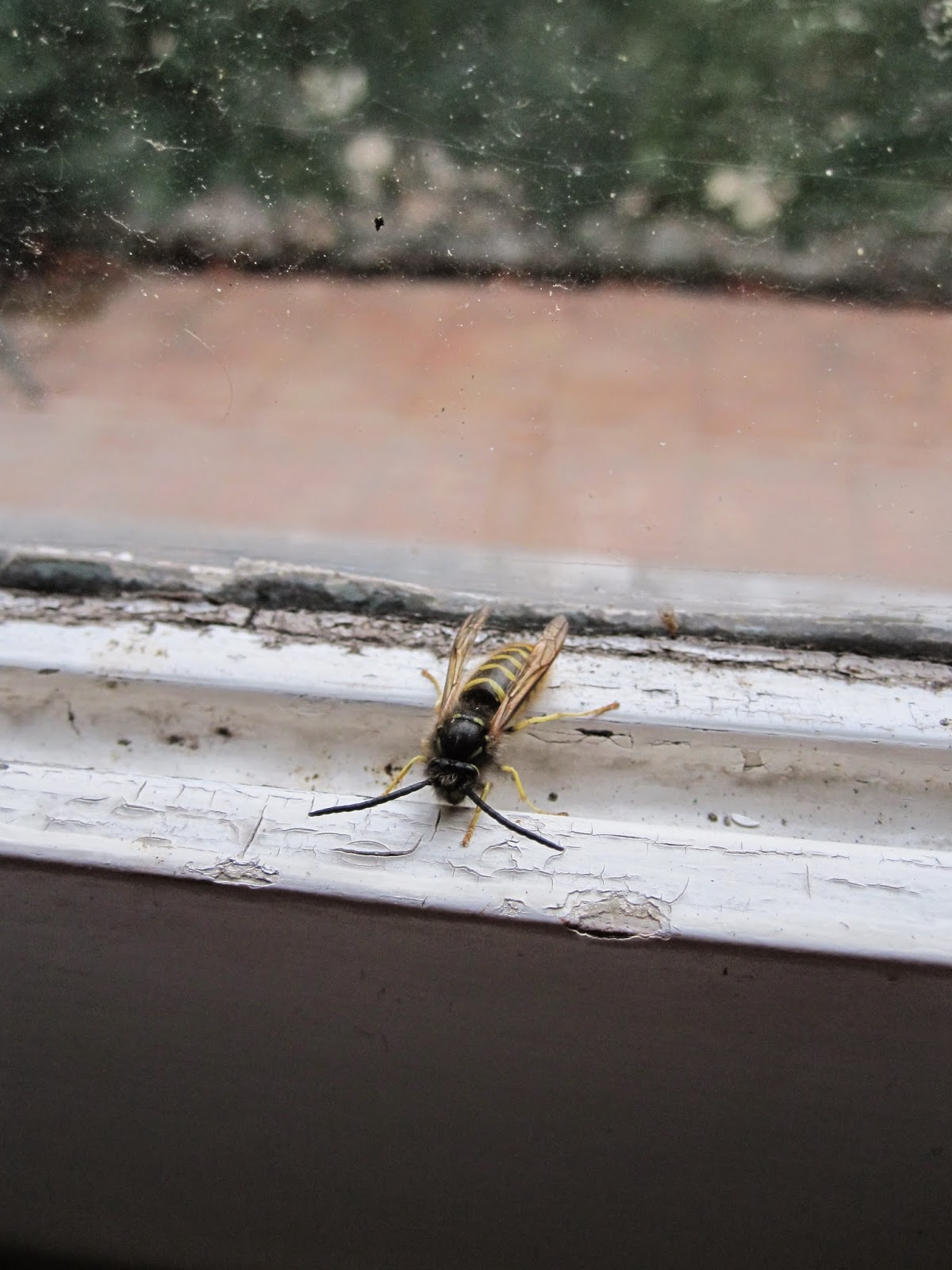
In getting to know the character of the place I have encountered other significant occupants in addition to my human neighbours. The man from the brandweer assured me that the wasps from the nest in the roof who have been gathering in significant numbers on the kitchen window were sleepy and likely die now that winter was coming and the best thing I could do would be to release them - which I did - about thirty or so individually by knocking them gently into a small wicker tea strainer and then tapping them out onto the window sill in the terrace outside from where they could fly off to the freedom of an uncertain future. 
Above a wasp in the kitchen before being released 
and below a fragment of one of several long since 
abandoned nests discovered in the ceilings

I discovered a mummified mouse behind the tongue and groove cladding which I am removing in the living room. Goodness knows what I will discover when I start to dig the trench for the septic tank and drainage...


Of all my neighbours however the most significant are the great horse chestnut tree and its companion beech tree in the garden adjacent which shelter the gable end of the house shedding between them a vast quantity of leaves, beechnuts and horse chestnuts which clog up the guttering and have to be continually swept. 

The Beech Tree
The Horse Chestnut Tree
Apart from the voices of tourists and the clatter of wheeled cases on the cobbles the sound of birds and bells adds significantly to the sense of both place and space especially in the morning when I open the door to the terrace and look up. 


Reading 'Walden' during a lunch break ........
Reconstruction of Thoreau's cabin at Walden Pond, Massachusetts from a visit I made a few years ago.  


Sunday, October 26, 2014

Squaring the Circle in London

Olafur Eliasson - Colour Experiment No #57 
Black Square 1915
Kazimir Malevich
Back from the High School London Art Trip two images stay firmly fixed in my mind, Olafur Eliasson's colour experiments based on the palettes of Turner's late paintings in the Tate Britain exhibition, 'Painting Set Free'.  Exploring the spectrum of colour and light in a traditional format these large minimalist paintings recall for me the elemental shape of the neophrite 'jade' disks of neolithic China. The jade Bi disk is thought to represent 'heaven' whist it accompanying square 'Cong' corresponds to earth, a parallel perhaps to the symbolism in Western antiquity and the geometry of Renaissance Italy explained  in Alberti's 'De re Aedificatoria'. The atmospheric light and colours of Turner great skies, often based on carefully calibrated layers of subtle nuanced complementary colours, are clearly evoked in this circular form and referenced in the smooth transitions colour.    


I bought the catalogue of an earlier exhibition by Ines Richter-Musso and Ortrud Westheider which took place in Hamburg, Krakow and Margate between 2011-2012 called, 'Turner and the Elements'. It does seem that although Turner's paintings are clearly situated in specific historic times and places relative to and conditioned by his life and journeys he is actually concerned with the timeless motion of the elements, earth, air, fire and water and their ever changing cycles of creation and destruction and how this is also a part of the creative and imaginative life of the artist and his feelings and perceptions in relation to his own interior and the exterior phenomena of nature, and the nature of the medium of expression. 

Malevich's radical and iconic 'Black Square' of 1915 which I saw at the Tate Modern is surely the great grand mother of Rothko's Black Paintings of the 1960's which I recall seeing with students on another London art trip at the Tate in 2008.  Conjuring both light and darkness, space and form simultaneously they appear to be both solid form and empty void. Are they a window into deep space perceived through muted light or a wall of opaque dark matter ? 

Mark Rothko No 7 1964


Tuesday, October 14, 2014

Flesh and Stone


The title of this post alludes to Richard Sennett's book of the same name which explores 'The Body and the City in Western Civilization' 

Have managed to prepare a white gesso ground on eight new MDF squares 5x300x300mm ready to paint on and will begin soon.


Back from the first weekend of wall scraping in Bruges.I felt like Howard Carter in Tutankhamun's Tomb when I uncovered the 16th century oak spine beams still in rock solid condition


There does seem to be a strange 'symbiosis' between both of these projects - building up and stripping back layers accumulated over time on different surfaces

Looking forward to seeing 'Sense and Sensuality. Rubens and his Legacy' at the Bozar over the October break in between bouts of wall scraping. 


Ruben's, like Lucien Freud, a more recent figurative painter in the same tradition, makes the analogy between the oleaginous nature of 'skin' on the painted surface of the canvas and human flesh.  Despite the counter reformation iconographic rhetoric the real subject in his explosive overblown compositions is the existential drama of human flesh - its birth, growth, maturity and ageing, death and decay - and the power of the painted image to outlive its transient fleshy subject matter. 


'The Death of Seneca' Peter Paul Rubens. c1615

Lucian Freud, Painter Working, Reflection, 1993.


Pursuing these analogies further from previous posts between bodies of paint and flesh and flesh and stone in houses and cities it is interesting to see how the various states of growth and decay, destruction, renovation and restoration have occurred in cycles in this old building and the rest of the city. The marks of time have a certain honesty and beauty about them if we can look with a degree of equanimity and without too much desire or aversion at both our own bodies and the bodies of wood, stone, ceramics, paint and plaster that form the outer protective 'skin' we call home.

It will be some time before these surfaces have lime plaster, beeswax and terracotta on them and various nuanced shades of white paint and the natural colour of stone, wood and raw linen to soothe the eye and gladden the heart...........but in the mean time they are a suitable subject for practical meditation in the spirit of the Upajjhatthana Sutta and its five recollections that should be reflected upon frequently 


1.I am sure to become old; I cannot avoid ageing.
Jarādhammomhi jaraṃ anatīto....
2.I am sure to become ill; I cannot avoid illness.
Vyādhidhammomhi vyādhiṃ anatīto....
3.I am sure to die; I cannot avoid death.
Maraṇadhammomhi maraṇaṃ anatīto....
4.I must be separated and parted from all that is dear and beloved to me.
Sabbehi me piyehi manāpehi nānābhāvo vinābhāvo....
5.I am the owner of my actions, heir of my actions, actions are the womb (from which I have sprung), actions are my relations, actions are my protection. Whatever actions I do, good or bad, of these I shall become their heir.
Kammassakomhi kammadāyādo kammayoni kammabandhū kammapaṭisaraṇo yaṃ kammaṃ karissāmi kalyāṇaṃ vā pāpakaṃ vā tassa dāyādo bhavissāmī.