About Mhttps://sites.google.com/view/metamorphoses-alan-mitchell/metamorphoses-alan-mitchelle

This blog was started during a half-year sabbatical from full-time art teaching at St. John's International School in 2013 to develop my painting within the context of a Masters programme, charting my developing work in progress and related interests. Since retiring from full-time art teaching in 2025 I plan to continue to make posts that chart a developing meditative practice in art and life. If you click the link in my profile you can view more work on my website.

Saturday, August 22, 2015

Black and Gold

'Agnes Martin' at The Tate Gallery ends on October the 11th 2015.

Struck initially by the similarity between the strong but understated abstract expressionist grid paintings of Agnes Martin and the regular patterns of brickwork that are such an integral part of both the emotional and built environment in Bruges I found her recently published biography, 'Agnes Martin: Her Life and Art' by Nancy Princenthal in the Raaklijn bookshop. Her practical interest in Zen Buddhism and Asian philosophy is clearly present in her statements about getting rid of intellectual 'ideas' and being 'empty' to respond to pure emotional inspiration not as an expression of personal ego. 

After leaving New York she appeared to renounce the comfort and security of more conventional artists, painting 'with her back to the world' and living a largely spartan solitary life in an adobe house she built herself in New Mexico. She abandoned painting for seven years but this period of transition, along with her closeted homosexuality and periods of mental turbulence were also perhaps important springs of independence and inspiration - her 'voices'. Later in life she enjoyed considerable success, fame and cult status ironically perhaps given her self-effacing self-imposed reclusive lifestyle.

'The beauty is not in the rose the beauty is in your mind'

The context for this statement can be found in the link below.
Tate Shots: Agness Martin

Agnes Martin, Friendship, 1963, incised gold leaf and gesso on canvas.
Still working on a series of black and white paintings for F which keep changing as further layers 'subtract' earlier layers by a process of 'addition'. This is their current status below.


Agnes Martin felt that music was the best and highest form of art because it was completely abstract and drew a powerful emotional response from the listener.

During the summer I was able to hear three concerts which formed part of the MA festival of early music in Bruges. The Vox Luminis ensemble's perfomance of Giacomo Carissimi's counter reformation oratorio Jepthte and Vanitas Vanitatum alongside compositions by Luigi Rossi, Domenico Mazzocchi and Kaspar Förster at the Sint Jakobskerk was the most moving and powerful for me.  The others MEDIA VITA Stile Antico at the Sint Walburgakerk and  IL TRIONFO DEL TEMPO E DEL DISINGANNO by G.F. Handel with Dunedin Consort ensemble at the concertgebouw which presented an allegorical duel between vanity and transience. 


The following three paintings from the fugitive image series are currently on display at the Raaklijn bookshop in Bruges. http://www.raaklijn.be/nl/


Gothic Revival......

My formative years, between the age of 11 and 18, where spent in Lancashire in the North of England in a largely late Victorian Gothic Revival building. We followed a rather monastic daily schedule that included morning mass and night prayers.  This pre-computer world included the old classical tradition of naming year levels by the subjects studied at these various stages; middle school 6th, 7th and 8th grade were called, 'underlow', 'low figures' and 'high figures', whilst high school 9th and 10th grade were, 'grammar' and 'syntax' respectively, and 11th and 12th grade 'poetry' and 'rhetoric'. Whilst I endured five years of Latin with only moderate success, I focused on English Literature, Art and Ancient History at 'A' level passing with As, although by that time I was rebellious, disenchanted and disengaged by a system which felt like it was out of touch, at least with my emerging view of reality, and ready to escape to London and art school.

The Chapel.
The South Wing from the Upper Lake.

In retrospect is it possible to see how in the 1880s such a pile of masonry could have grown as a visual and material embodiment of strongly held identities, values and world views, particularly in Lancashire, which since the reformation had remained staunchly Catholic with significant pockets of resistance in the local recusant gentry and large influxes of Irish poor into cities like Liverpool following the potato famine.

The poems of Gerard Manley Hopkins, (1844-1889) which I studied at this time, remain as vivid individual expressions of feelings and perceptions transformed into art and language of one who lived through these transformations. This one is particularly poignant. 

Spring and Fall

to a Young Child

   Margaret, are you grieving
   Over Goldengrove unleaving?
   Leaves, like the things of man, you
   With your fresh thoughts care for, can you?
   Ah! as the heart grows older
   It will come to such sights colder
   By and by, nor spare a sigh
   Though worlds of wanwood leafmeal lie;
   And yet you will weep and know why.
   Now no matter, child, the name:
   Sorrow's springs are the same.
   Nor mouth had, no nor mind, expressed
   What héart héard of, ghóst guéssed:
   It is the blight man was born for,
   It is Margaret you mourn for.

Criticism of the worst excesses of a materialistic, 19th century commercial, industrial, capitalism, crystallize in the writings of John Ruskin, who championed amongst many other things, public libraries and drawing classes for working men, and William Morris, whose socialist utopian vision was expressed in 'News from Nowhere'. The Arts and Crafts movement spreading out from Britain would later influence the Bauhaus. Augustus Pugin's Gothic revival architecture pitches his version of the middle ages against the facades of commercial 'classical' Georgian architecture, and the romantic medievalism and social insight in the paintings of the Pre-Raphealite Brotherhood provided an aesthetic background to John Henry Newman's conversion to Catholicism and The Oxford Movement, which articulated voices of dissent from within the English establishment, with their focus on social reform, spiritual renewal and revival. 

From Pugin's 'Contrasts' published in 1836
The demographics of history, economic and social life in the growing cities of the North of England provided a fertile soil for such ideas to grow into. Some of the building's which followed survived only a hundred years into the late 20th century, as in the case of my old school, and are now abandoned and falling into decay and dereliction, awaiting perhaps their own renaissance in a future cycle of regrowth and regeneration? 

Sunday, July 12, 2015

A Place Beyond Belief.....


Nathan Coley, 'A Place Beyond Belief ', Burg, Brugge Triennale 2015
Following our philosophy lunchtime reading class based around the text, 'On the uses and disadvantages of history for life' from the second 'Untimely Meditation', have been musing on what Nietsche describes as three types of history ( monumental, antiquarian and critical)  in relation to the Triannale which has just opened in Bruges,http://www.triennalebrugge.be/en with the intention of using contemporary art and architecture in this historic city to, in the words of the curators, 'pose questions about the future and the potential of the city, about urbanisation, citizenship, lifestyle, community, economics, energy, space, sound and the values that guide us'

........; every man, and every nation requires, in accordance with its goals, energies and needs, a certain kind of knowledge of the past, now in the form of monumental, now antiquarian, now of critical history.  

Monumental history is the masquerade costume in which their hatred of the great and powerful of their own age is disguised as satiated admiration for the great and powerful of past ages .......

 and
 .... any art which, because contemporary, is not yet monumental, seems to them unnecessary, unattractive and lacking in authority conferred by history.

 and of antiquarian history

 History thus belongs in the second place to him who reveres it - to him who looks back to whence he has came into being, with love and loyalty............
 and yet

  .....Antiquarian history itself degenerates from the moment it is no longer animated and inspired by the fresh life of the present

 and of critical history,

If  he is to live  man must possess and from time to time employ the strength to break up and dissolve a part of the past , he does this by bringing it before the tribunal, scrupulously examining it and finally condemning it;.........

But

If  we condemn these aberrations and regards ourselves as free of them, this does not alter the fact the we originate in them.......


 Romy Achituv, Cataract Gorge 
Sasplein 
"Romy Archituv creates an artificial storm on the otherwise placid waters of Bruges. Floating on the turbulent waters is a structure in the form of the a Gothic crow- stepped gable house. The work refers both to the city's economic heyday hundreds of years ago and to the current stagnation of a city that seems to exist solely for the purposes of entertaining tourists. Strict regulations intended to preserve the city's heritage act as brakes to evolution and a dynamic future. " 


In the Arentshuis 'The Visionary City' an exhibition based on German architect Oswald Mathias Ungers book of 1982 'Morphologie, City Metaphors' and the Cooper-Hewitt Meseum exhibition recreates his visionary juxtaposition of associated images and words that create a kind of poetic laboratory for urban imaginings. The second part of this exhibtion is dedicated to the Belgian architect Huib Hoste's and Paul Michel Aumery's largely unrealised progressive urbanisation plan for Bruges in the 20th century.

                                From Ungers' forward to Morphologie, City metaphors


Of the various installations questioning the nature of contemporary experience in witty and ironic ways some the following have already caught my eye including the rotating chocolate bourse that challenges our 'sweet addiction' to consumer capitalism with a very Belgian and Bruges specific reference....... 


 Rainer Ganahl: Uber Capitalism 
........and in the city of globalised mass tourism during a summer of economic, social and political migrations the question of what constitutes the rights and responsibilities of European and global citizenship in the 21st century seems to be on many people's minds and this is well focused by Daniel Dewaels  'The Passage Room' just outside the station.


 Daniël Dewaele  The Passage Room 

My personal favorite installation of those I have seen so far both for its site specific location and dreamlike quality is Tadashi Kawamata's Tree Huts in the Beguinage that adds a poetic contemplative twist to this quiet Benedictine monastic enclave in the heart of Bruges' tourist maelstrom. Nesting in the upper branches of the tall trees surrounded by leaves rustling in the breeze these imaginary dwellings speak to our deepest instincts as do the small houses cloistered around the church in a community of ordered routines in peaceful retreat centred on the cultivation of silence and the interior life 


Tadashi Kawamata's Tree Huts 

Tuesday, May 19, 2015

My Mind to me a Kingdom is..........


Following an initiative led by our philosophy teacher W.D. have started to read '
Nietzsche and Zen, An Essay in Philosophical Theology', by Stephen Priest which I discovered online from  The Dalai Lama Centre for Compassion http://compassionoxford.com/  in addition to re-reading Robert Morrison’s ‘Nietzsche and Buddhism - A study in ironic affinities’ as supplementary texts to the Nietzsche 'neat' we are reading together. 
This is a brief summary from the ‘Nietzsche and Buddhism book cover.
‘Nietzsche’s view of Buddhism has been very influential in the West; Dr Morrison gives a careful critical examination of this view, argues that in fact Buddhism is far from being a nihilistic religion, and offers a counterbalancing Buddhist view of the Nietzschean enterprise. He draws out the affinities and conceptual similarities between the two, and concludes that , ironically, Nietzsche’s aim of self-overcoming is akin to the Buddhist notion of citta-bhavana ( ‘mind-cultivation’). Had Nietzsche lived in an age where Buddhism was better understood, Morrison suggests, he might even have found in the Buddha a model of his hypothetical Ubermensch’
'A' thoughtfully brought these geraniums for the window boxes in Brussels yesterday evening and planted them in. The complementary deep red against the green foliage of the trees is very satisfying to contemplate when you look up from reading a book with a cup of tea in those 'idle' moments......

Who after all needs an Olympic size swimming pool and acres of lawns 
when you can have a window box instead....... ? 

The title for this post comes from the opening verse of this poem redolent with stoic values attributed to Sir Edward Dyer and set to music by William Byrd and sung here by Emma Kirkby in a recording by Fretwork. 


MY mind to me a kingdom is;
  Such present joys therein I find,
That it excels all other bliss
  That earth affords or grows by kind:
Though much I want that most would have,        5
Yet still my mind forbids to crave.
 
No princely pomp, no wealthy store,
  No force to win the victory,
No wily wit to salve a sore,
  No shape to feed a loving eye;        10
To none of these I yield as thrall;
For why? my mind doth serve for all.
 
I see how plenty surfeits oft,
  And hasty climbers soon do fall;
I see that those which are aloft        15
  Mishap doth threaten most of all:
They get with toil, they keep with fear:
Such cares my mind could never bear.
 
Content I live, this is my stay;
  I seek no more than may suffice;        20
I press to bear no haughty sway;
  Look, what I lack my mind supplies.
Lo, thus I triumph like a king,
Content with that my mind doth bring.
 
Some have too much, yet still do crave;        25
  I little have, and seek no more.
They are but poor, though much they have,
  And I am rich with little store;
They poor, I rich; they beg, I give;
They lack, I leave; they pine, I live.        30
 
I laugh not at another’s loss,
  I grudge not at another’s gain;
No worldly waves my mind can toss;
  My state at one doth still remain:
I fear no foe, I fawn no friend;        35
I loathe not life, nor dread my end.
 
Some weigh their pleasure by their lust,
  Their wisdom by their rage of will;
Their treasure is their only trust,
  A cloakèd craft their store of skill;        40
But all the pleasure that I find
Is to maintain a quiet mind.
 
My wealth is health and perfect ease,
  My conscience clear my chief defence;
I neither seek by bribes to please,        45
  Nor by deceit to breed offence:
Thus do I live; thus will I die;
Would all did so as well as I!


Sunday, May 17, 2015

'Only connect'.......

E. M. Foster's admonition to 'only connect' seems like a good principle to follow in life and art. 

After hearing Paul Van Nevel's http://www.huelgasensemble.be/welcome.php' Music for Apocalyptic Times 1200-1400 last week with R in Notre Dame de la Chapelle in Brussels and last Friday evening a concert by La Chapelle Sauvage http://www.lachapellesauvage.be/at the Onze Lieve Vrouw Kirk in Brugge I have been considering the connection between the sound of the human voice and the particular acoustics created by these sacred spaces constructed largely from traditional materials like stone, brick, plaster and wood. 

Birth- The Nativity by Pieter Pourbus- overlooked by the angle of death surmounting a marble tombstone in the Onze Lieve Vrouw Kirk, Brugge.   
It may be that the natural hydraulic lime which I am using to point and render the old bricks both inside and outside of the house has particular acoustic properties which resonate to sound vibrations in the same way that it absorbs and refracts light to create a very subtle muted colour in addition to 'breathing' naturally with the changing weather conditions. 


Bricks and plaster can become fascinating surfaces especially if you are stripping back, pointing and re-rendering these surfaces just for their natural beauty. It is a salutary lesson to any artist to remember that Michelangelo had to be an expert lime plasterer in order to paint fresco's which like require three layers moving from coarse to fine progressively, which is the same even if you are not painting the Sistine Chapel.........! 

Consolidating and conserving old brick work seems to be driven by both necessity and aesthetics -this labour of love requires patience and judgement but the result has a modern rustic appearance that can be  very satisfying - as long as the rest of the space is clean and warm, fully fitted with hot and cold water and does not remain a building site. 


The effects of light on gently modelled surfaces of natural lime plaster in both real and imaginary spaces, seems to be the subject of most of Fra Angelico's frescos in the monk's cells at San Marco's in Florence in which art and life, interior and exterior worlds, mirror and reflect each other. 


Now that the 'vergunning' has arrived the work is finally scheduled for the end of June and I can look forward to a summer of chipping back loose plaster and render, scraping out the joints, pointing and rendering brickwork both inside and out where necessary whilst the builder, plumber and electrician complete the essential works over July

Terrace wall being prepared for pointing.
Meanwhile elsewhere I continue to experiment with further abstractions for F using Bauhaus inspired elements in a project I am sharing with the 9th grade art class based on composing with squares and other simple geometric forms within a frame. They have to research Klee, Kandinsky, Albers and Itten as part of their investigation and search out the connections between art, music, dance and drama in specific examples of these artists works. Below are a few examples of my own works in progress......... 


GA Series 3 a - various stages.


GA series 3 b


Tuesday, May 5, 2015

Art Brussels and Antwerp Zoo

.


Visited Art Brussels with AA a couple of weeks ago. Existentialist statements presented in forms familiar from popular consumer culture challenged the viewer with subtle dissonance and mild disjuncture between form and content that seemed to be echoed throughout by both the venue and format of Art Brussels itself in what appeared packaged and marketed as a large industrial trade show of galleries in what is essentially a warehouse or hangar size environment dedicated to the network of global consumerism sponsored by a medley of brands and corporate finance. I suppose the church and feudalism sponsored the art of the middle ages in a comparable if  somewhat different cosmos 600 years ago.   

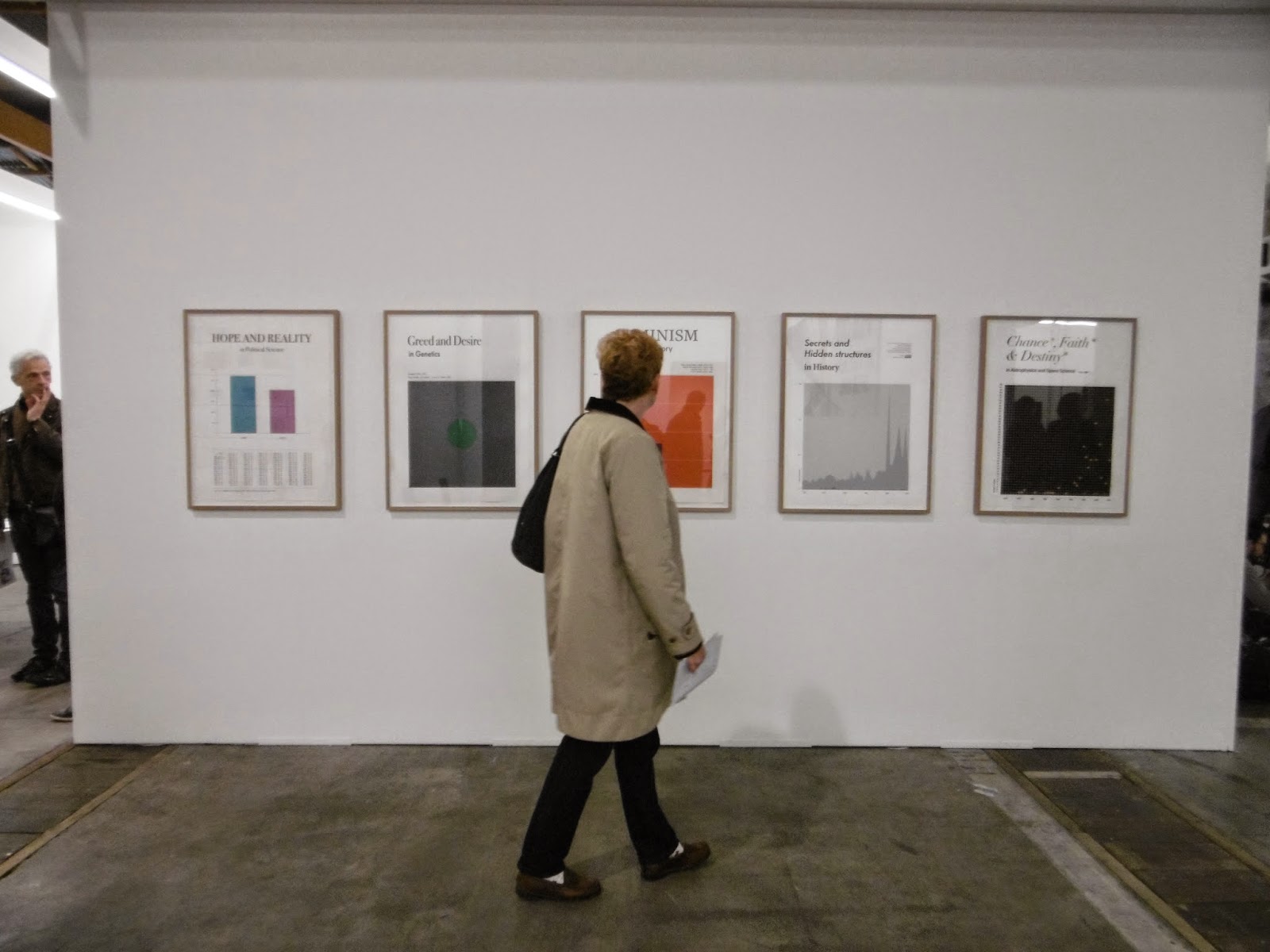
There was a plethora of clever visual conceits and double ironies.  Oslo Contemporary had a display of statistical charts that appeared to suggest, perhaps not absurdly or ironically given contemporary educational practice in some quarters, that there could be measurable data for the following categories: Secrets and Hidden Structures in History, Greed and Desire in Genetics, Hope and Reality in Political Science, Feminism in Theory, and Chance, Faith and Destiny in Astrophysics and Space Science.  


I found myself aestheticising the banal and ordinary in much the same way that several of the 'works of art' seemed to be doing in a playful and engaging manner..........

Work of art 

Floor of Art Brussels 

Work of art 


White box conspicuously 'hiding' electronics 

Gallery chair with ubiquitous laptop 

On earlier trip to Antwerp Zoo with A I captured an image of this strange creature behind the glass in the reptile house - its a great place to observe people, especially if you are an animal.


Friday, April 10, 2015

'Vergangkelijkheid' in Antwerp.


'Chapter 2' Koosterstraat 106, Antwerpen 

The Buddhist Pali term 'annica' often translated into English as impermanence would be  'vergangkelijkheid' in Dutch which means perishableness, transitoriness and instability. 

Riding down the Kloosterstraat in Antwerp on Friday I came across a temporary exhibition in a rented gallery space that captured my attention by both its strong visual and conceptual unity, creative economy of means and by its quality of  'Vergangkelijkheid'.  

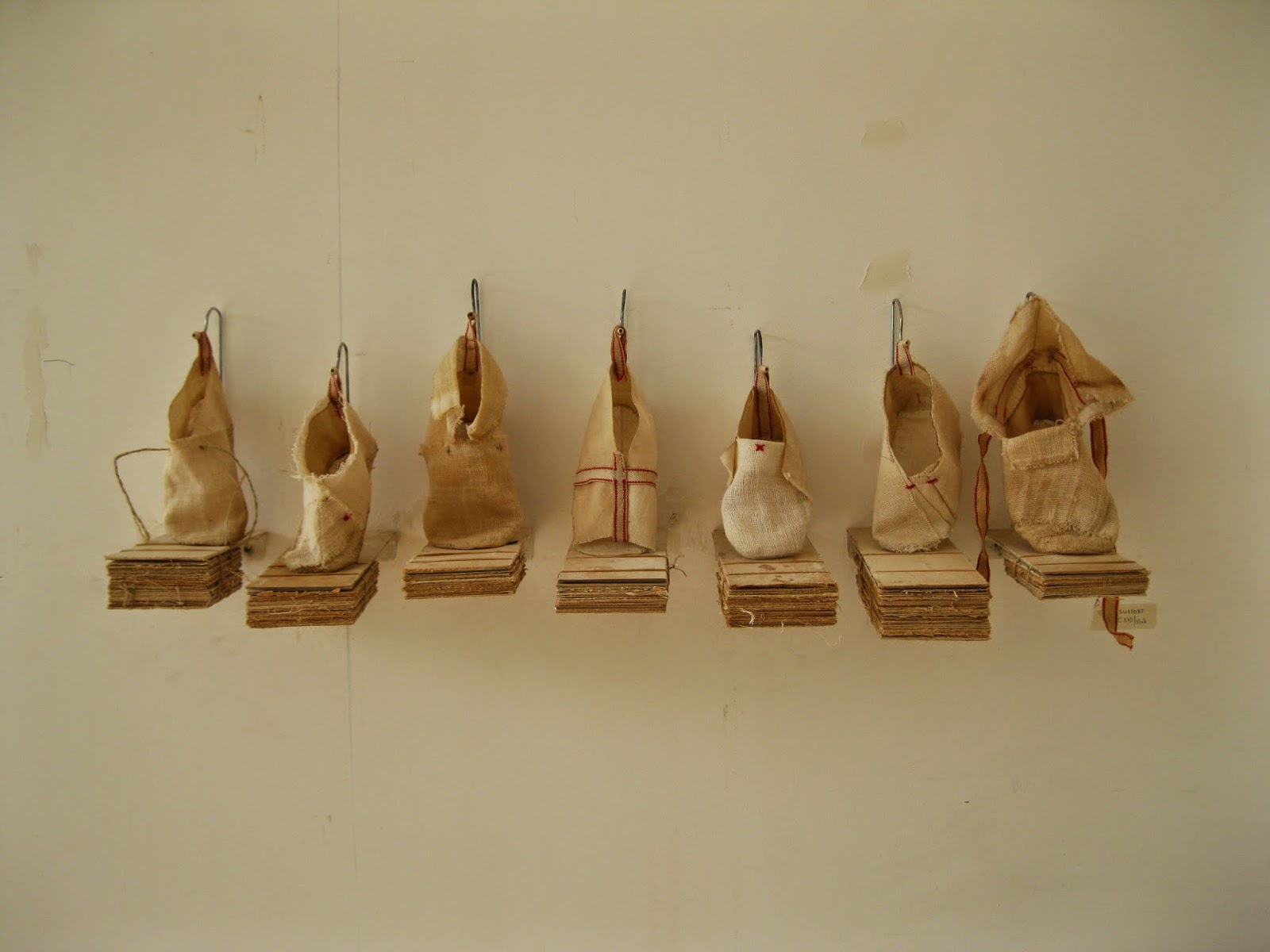
The apparent fragility of the two and three dimensional materials and the seemingly bleached and faded quality of the colours with their luminous layered and transparent 'skins' evoked a similar feeling to the one I get when I see bones or shells. It was as if something living and human had shed its skin, leaving behind an outer layer, an implied presence, an impression or a stain which was both personal and impersonal, animate and inanimate at the same time. It seemed also as if something was simultaneously being created and dissolving and disappearing.

 As Gert Van Dessel, one of the three artists in the exhibition explained to me, this kind of work is not to every one's taste. For me it seemed to undermine the very idea of satisfying the constantly fuelled desire for the bright shiny, new and 'permanent' objects of our advertising driven consumer culture even while it appeared to conjure this context in a shop-like space.    

The exhibition runs from 4th April until 3rd June 2015 and is open Wednesday to Sunday from 11-18 hrs. This Gert's website http://gertvandessel.be/