About Mhttps://sites.google.com/view/metamorphoses-alan-mitchell/metamorphoses-alan-mitchelle

This blog was started during a half-year sabbatical from full-time art teaching at St. John's International School in 2013 to develop my painting within the context of a Masters programme, charting my developing work in progress and related interests. Since retiring from full-time art teaching in 2025 I plan to continue to make posts that chart a developing meditative practice in art and life. If you click the link in my profile you can view more work on my website.

Monday, September 17, 2018

Beeswax and Books


Before the summer holiday Patrick and I constructed bookshelves in the alcoves either side of the fireplace based on rough designs and measurements. With a simple plinth and cornice and a few coats of white paint far from reducing the size of the room they seem to increase the space, especially with the hidden illumination behind the cornice, and give a better sense of scale and proportion to the room. The rhythm of the shelving creates a counterpoint to the rhythm of the ceiling beams and the horizontal lines of the plinth and cornice follow and carry over the lines of the window sills and mantle piece. They are ready to be filled slowly with the accumulation of books which has built up over the years. I am already imagining evenings in front of the fire in the depth of winter in the company of favorite writers, the act of reading requiring both quiet and comfort, one interior space supporting another. 


Upstairs I was finally able to give the new oak floorboards a stain of colour and coat beeswax This was physical hard work but one job at least that smelled nice - at least to my sense of smell. I first had to stain the boards to the right colour using a mixture of turpentine and burnt umber oil paint and then when this was dry a coat of of beeswax and turpentine. Finally the plinth was attached and painted white.


Thursday, May 24, 2018

Panel painting and the interior life .......part 1


Interior space, physical and psychological, are clearly connected and the last few months have found me making wood paneled window shutters, fitted bookcases with Patrick's help, and completing the interior spaces of rooms in the house as well as experimenting with wood, rabbit skin size, gesso, clay bole, gold leaf, egg tempera and oil paint in an attempt to recreate the materials and processes involved in making and painting a Medieval or early Renaissance wood panel. The purpose behind copying these paintings is to learn the technique with the intention of adapting it to my own original creative development of collage /painting ideas that I began working on when I first started this blog. At that time I was making work like the oil painting below which attempts to play with the space, real and illusory both inside and outside the real and painted frames, and evokes the torn paper and other surfaces, real and representational, on which images are made by photographic or other painted and printed means, revealing in a fixed form their fragile and transitory states.

The Fugitive Image: No 4.  Oil on Panel.  30x40cm

 Clearly the use of devotional images was an important aspect of developing an 'interior life' of the spirit through the imaginative use of icons and iconography and as an aid to framing states of mind conducive to and as a focus for contemplation and meditation in the Christian tradition. The material nature of these images was an important part of their power to make 'incarnate' ideas and despite their inanimate state they were often attributed with agency. Their age and survival, often in a damaged state, is part of their appeal and continuing power. The larger panel I have chosen to reconstruct is the one below by the Master of the Codex of St George in the Metropolitan Museum. 


Apart from these practical experiments research has included examining at first hand examples of gilded panel painting in tempera and oil paint including this wonderful panel by Simone Martine at the Walker Art Gallery in Liverpool which I have always loved since I first saw it as a young boy. I especially identified with this picture because Simone Martini with great psychological perception perfectly communicates the human relationship and the situation - parents reasoning with a difficult adolescent. It is interesting that like the painting I am copying for the larger of the two panel's this was also painted in Avignon in the 14th century. 


Apart from careful reading of Cennino Cennini famous "Il Libro dell'arte", which gives detailed instructions to the panel painter about how to prepare the gesso and add the gold leaf and paint in egg tempera,  I have an old copy of A.P Laurie's, 'The painters methods and materials' from school days,  and have also followed D.V Thompson's 'Materials and techniques of medieval painting' and 'The practice of tempera painting material and methods'. Using authentic traditional pigments and materials from Kramer the German paint manufactures https://shop.kremerpigments.com/en/ who still manufacture true ultramarine blue from Lapis Lazuli, I am able to follow closely the processes involved. I have also been carefully studying the examples of students reconstructions of early panel painting on the   Hamilton Kerr Institute  website. 

The small panel based on an early 15th century Flemish Madonna and Child in oil paint below has been a trial run for various techniques which I am refining on the larger panel including water gilding. The practical method of experimenting with both the materials and techniques by actually reconstructing the whole process is from an artist's point of view essential to understanding the works on their own terms and not just as theoretical ideas that are read about in books. Cennino Cennini writes as one craftsman to another not as a sociologist or academic. 
Laying the gold using a gilders tip and water size and alcohol liquor on top of the sanded clay bole
gilders 'leather' cushion and knife


Stages in making the panel below

Animal glue melted down to glue the wooden panel and moldings together 
Bain Marie to melt the rabbit skin glue to size the panel and glue the linen to the surface. 


gluing the wooden molding to the panel 

sizing the wooden panel with rabbit skin glue

gluing the linen to the panel with size 

The first layer of very fine gesso made from rabbit skin size and calcium carbonate.
Carefully filing and modeling the corners
Sanding back the many layers of gesso that build up. 

Scraping back the surface to make it very smooth like ivory

Tracing the image and transferring to the surface 
The faint lines of the transferred design
Working up the under-painted tonal image using Indian ink and brush 


Painting four layers of clay bole to prepare the surface for water gilding


water gilding and burnishing with a agate burnisher 


Completing the under-painting to work out tonal balance prior to painting the colours with egg tempera 

Clearly this is still a work in progress.......meanwhile elsewhere ............

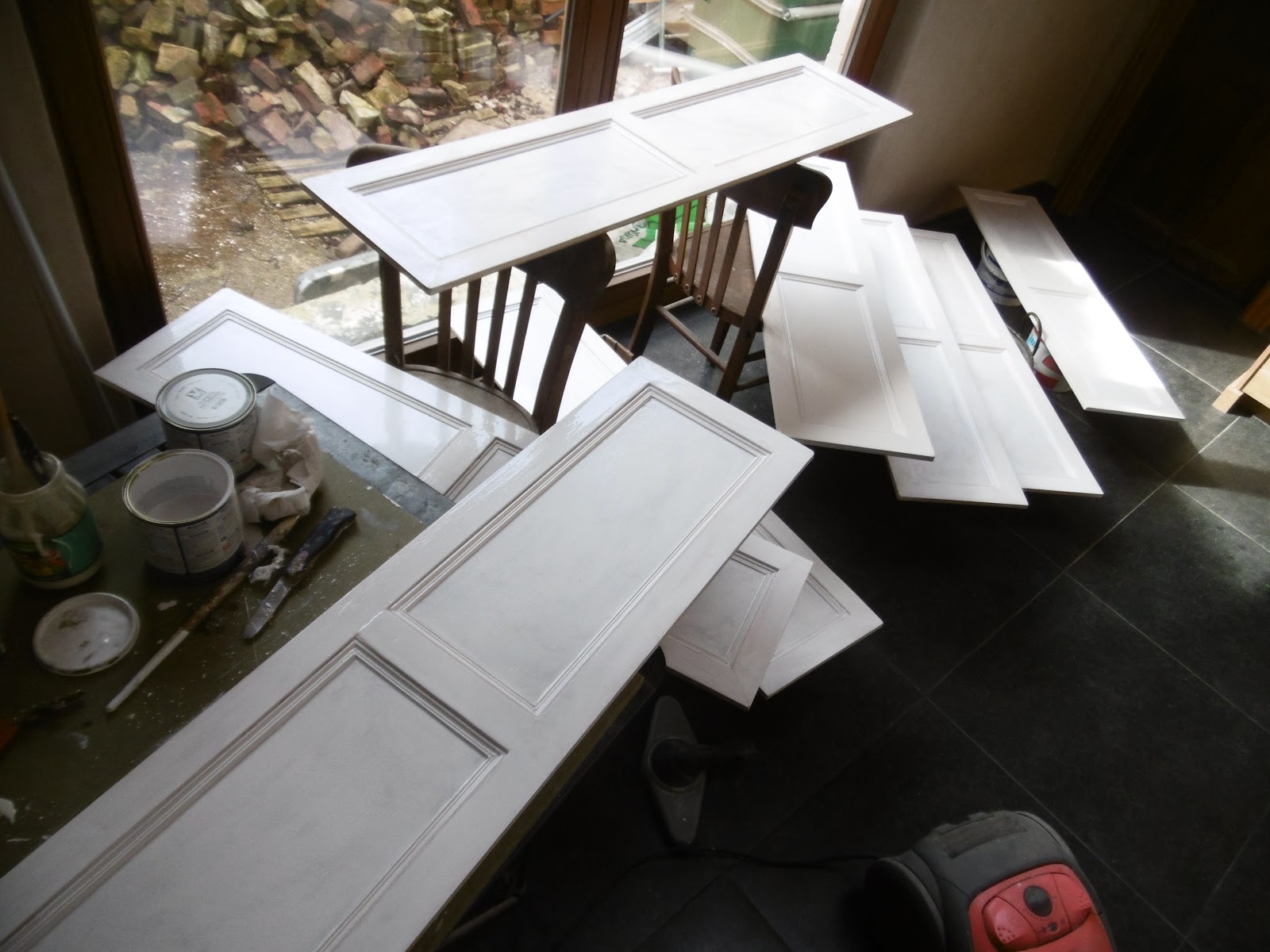
I have been preparing other panels in wood and paint to model the light and colour of the living room as it filters in through the windows at the front. As the cost of having traditional shutters was expensive I decided to measure up the panels I needed and make them myself. I used some thin plywood sheets cut to size with wooden moldings glued and nailed together, gaps and holes filled with some wood filler and sanded down before being painted with several layers of satin white and attached together with several small brass hinges. Having white paneled shutters, like adding gold to a painted panel, helps to reflect and increase light in the space, especially since the old glass in the front windows is slightly rose tinted. I had to make eight paneled hinged window shutters in all. The windows like the wooden painted panels frame the transition from interior to exterior space and vis-versa and are an important part of the atmosphere of the room. Opening and closing them in the morning and evening is a daily ritual, a necessity event that mediates the ever changing cycles of natural and artificial light and sensitizes one to these profoundly ordinary phenomena.


Shutters snugly mounted into the window frame and aligned to the newly fitted bookshelves.  
Adding gold leaf by water-gilding and burnishing with a mounter agate stone


Wednesday, January 31, 2018

The colour of silence


 The last exhibition by two visiting artists at St. John's featured recent work by Audrey’s Atkinson. 

Her work incorporates life drawing, photography, printmaking, painting, ceramics and silk-screen printed textiles with ideas emerging from numerous interesting sketchbooks. Recurring human forms and themes of architectural space and the effects of time on surfaces, a suggestion of projected or transferred photographic or cinematic narrative consisting of gestural human marks, calligraphic lines and layers of transparent and opaque paint both reveal and obscure the image. This painterly technique has been transferred through printmaking processes to functional and decorative fabrics like silk and linen, creating flexible and interactive works that extend the language of the paintings into fashion and textile design.
           

One painting in particular (below) has drawn me back repeatedly by its quiet insistence on measuring time and space. Contained within a simple flat square the painting, built up in opaque and transparent layers of paint, collage and transferred photographic fragments, seems to frame an inner square that recalls a wall, window or floor plan in the visual language of modern geometric yet painterly minimalism, reminiscent of a Kurt Schwitters collage. The muted colours and tinted whites, both smooth and gently textured, have the feel of plaster, paper or ink and explore an association between the various acts of writing, drawing, printmaking and projecting photographic images into and onto architectural spaces and surfaces.  Like silence, which is not without the background noises which one becomes aware of when the mind itself settles down, the painting presents an 'emptiness' in the centre of several peripheral points of focus towards the corners and sides where small rectilinear 'windows' open to reveal glimpses of space behind. The more one looks at the empty, white, bland centre the more it becomes 'full' as one adjusts to the finely calibrated close tones, textures and hues from which it is constructed or rather which remain behind as 'negative space' after the peripheral action of building up positive shapes has been completed. This is a painting that rewards contemplation by drawing in and enfolding the eye of the viewer through it undemonstrative gentleness in much the same way that the ear of the listener becomes more sharply attuned to a whisper in a quiet room by craning the head to catch the faint sound. 


A visit to Audrey's 'studio' reveals a similar aesthetic sense of spatial organisation, subtle muted colour, light and contrasts and an integration of art and life, action and contemplation. The paintings and fabric prints are enhanced perhaps by being stacked against walls in layers, hiding and revealing themselves simultaneously and extending the metaphor contained within the picture's frame into the frame of the room and beyond.  Audrey's work has developed significantly over the twenty years I have known her but it retains and increases its powerful expressive aesthetic qualities by compressing complex multiple layers of significant marks and gestures into a surface that is minimalist and simple and increasingly stripped bare of inessentials.


Monday, December 11, 2017

Old Music, Contemporary Art


I had the opportunity this year of hearing two of Montiverdi's works at the concertgebouw in Bruges. Orfeo in August and The Vespers in October.  On a visit to the Palazzo Ducale in Mantova over the summer I was able to see the room where Montiverdi's 'Orfeo' was first performed - as well as Mantegna's wonderful tromp l' oeil fresco paintings of the Gonzaga family in the Sala delgi Spozi. These long dead faces from a family portrait live on in the thin layer of paint and plaster on a wall that has apparently absorbed the past occupants of the room and communicated their visible essence back to us like a mirror that mediates past and present.  


Strangely perhaps, its the corners or edges of things that frame the main subject that interest me most, and the smaller less important rooms where light from windows on simply plastered walls and space perceived or suggested through open doors become the central more intense focus of contemplation. This room above in Mantova has some of the qualities I would like to create in the rooms below in Bruges


The patterns and forms we imprint in time and space, the traces of our living movement, remain behind, long after we have gone, fixed in inanimate forms and surfaces, like a shell or bone.  A  molded and painted surface of plaster is reanimated by the reflected gaze of successive generations and a score of music comes to life again in living breath of its performers and the ear or the audience. 
Building and modeling a small plastered wooden panel with a rounded arch and preparing a smooth gesso ground with successive layers of sanded plaster and paint ready to paint on is very like the process of preparing the walls in the house. First ensuring the structure is sound and all cracks and joints are consolidated, then building up successive layers of rough and smooth lime plaster to produce a flat smooth surface before building up layers of creamy white lime paint that will frame the light and space of the room rather like the panel will frame the sacred image with its surrounding of reflective gold leaf. Both seem to bring a mystery to life and both seem like repetitive, reflective, meditative and contemplative activities best pursued in quiet seclusion. Both are challenges that require effort, both bring an intense satisfaction and contentment.  

Follower of Rogier Van de Weyden. c1500 Virgin nursing the Christ Child

William Kentridge's 'Smoke, Ashes and Fable' at Sint. Jan's Hospital explores the past in dreamlike narratives that cross the boundaries between film, photography, animation, drawing collage and installation. Text and image become the means by which personal memory, myth, history and imagination are brought to bear on the theme of time and transience which resonates with this particular place where sickness and death were mediated with medicine, art and religion for hundreds of years. 

I was reading Alan Hollinghurst's, 'The Stranger's Child' over the break and this also resonated with themes of time and transience. Several generations of a family are the subject of literary research and personal memory as the words and manuscripts of the fictional first world war poet Cecil Valance are scrambled and reconfigured and re-contextualized by the changing times and fashions up to the present day. What is perhaps significant is not so much what is remembered as how much is forgotten, lost or misunderstood. 

One is reminded of W.H Auden's poem 'In Memory of W B Yeats' 

'The words of the poet are modified in the guts in the living' 

From 5th  May  -16th September 2018 the Bruges Triennial will explore the 'liquid' nature of contemporary globalized society with artists and architects converging on the historic centre of the city to explore the relation and resonances between old and new. I plan to take an art trip to explore this with students. The text below comes from the website. 

'A state of constant flux, driven by variation, pluralism and ambivalence can lead to uncertainty and even fear. But Bruges Triennial 2018 adopts the opposite stance as a possible beacon, a fluid city, open and involved, the engine of social, cultural and political change. Bruges as a creative melting pot where diversity leads to encounter. A seedbed for innovation in an urban context. With their artistic and architectural installations, the artists participating in Bruges Triennial 2018 | Liquid City – Vloeibare Stad create hospitable public spaces in the inner city. The temporary modifications they make to lesser-known and iconic places in the historic cityscape open up new opportunities for dialogue for residents and visitors alike.'
https://www.triennalebrugge.be/en 

...........and in May also 'Gold-Brugse Stemmen Uit De Renaissance'  brings ancient works from the golden age of Bruges performed by contemporary musicians to various venues in the city with music from three masses.  The Tallis Scholars perform Obrecht, Missa de Sancto Donatiano in the Sint. Jacob's Kirk, the Huelgas Ensemble Clement. Missa Gaude lux Donatiane at te Concertgebouw and Psallents, Obrecht. Missa de  Sancto Martino at the Onze-Lieve Vrouwekerk, all taking place over the long ascension weekend and not to be missed !
 My own walls upstairs in the renovation are finally turning to a soft white creamy colour and as I fill, plaster, sand, smooth and give a first layer of lime paint my thoughts are turning to what I will hang and where. I will give pride of place to my father's collage which depicts a very particular Northern English landscape that could include references to any number of places from Liverpool to Lancaster with the mountains of the Lake District or North Wales in the background seen over either Morecambe Bay or the Mersey Estuary and an industrial townscape landscape with buildings from the 16th to the 20th century. 

His method and process is to slowly build up the image from tiny fragments of torn paper from magazines etc that have the correct colour, pattern or texture. These reconstituted elements combine with drawing and layers of fine painting  to create a landscape of recollection, memory and reconstruction that is as accurate an evocative of both the feel and appearance of Northern industrial England as it is as unspecific about a particular or exact location, place or topography. This as much an interior as an exterior landscape, invented from observations collected and stored, and from memory and imagination and it is perhaps surprisingly more real and potent because of it. 

 
From the long extinct smoky chimneys of Northern England to the smoke, ashes and fable of William Kentridge's exhibition I added my own woodsmoke this weekend and was glad of it with the cold weather and sudden snow fall. Home is where the hearth / heart  is......