About Mhttps://sites.google.com/view/metamorphoses-alan-mitchell/metamorphoses-alan-mitchelle

This blog was started during a half-year sabbatical from full-time art teaching at St. John's International School in 2013 to develop my painting within the context of a Masters programme, charting my developing work in progress and related interests. Since retiring from full-time art teaching in 2025 I plan to continue to make posts that chart a developing meditative practice in art and life. If you click the link in my profile you can view more work on my website.

Friday, August 2, 2024

Bones, leaves and stones ...

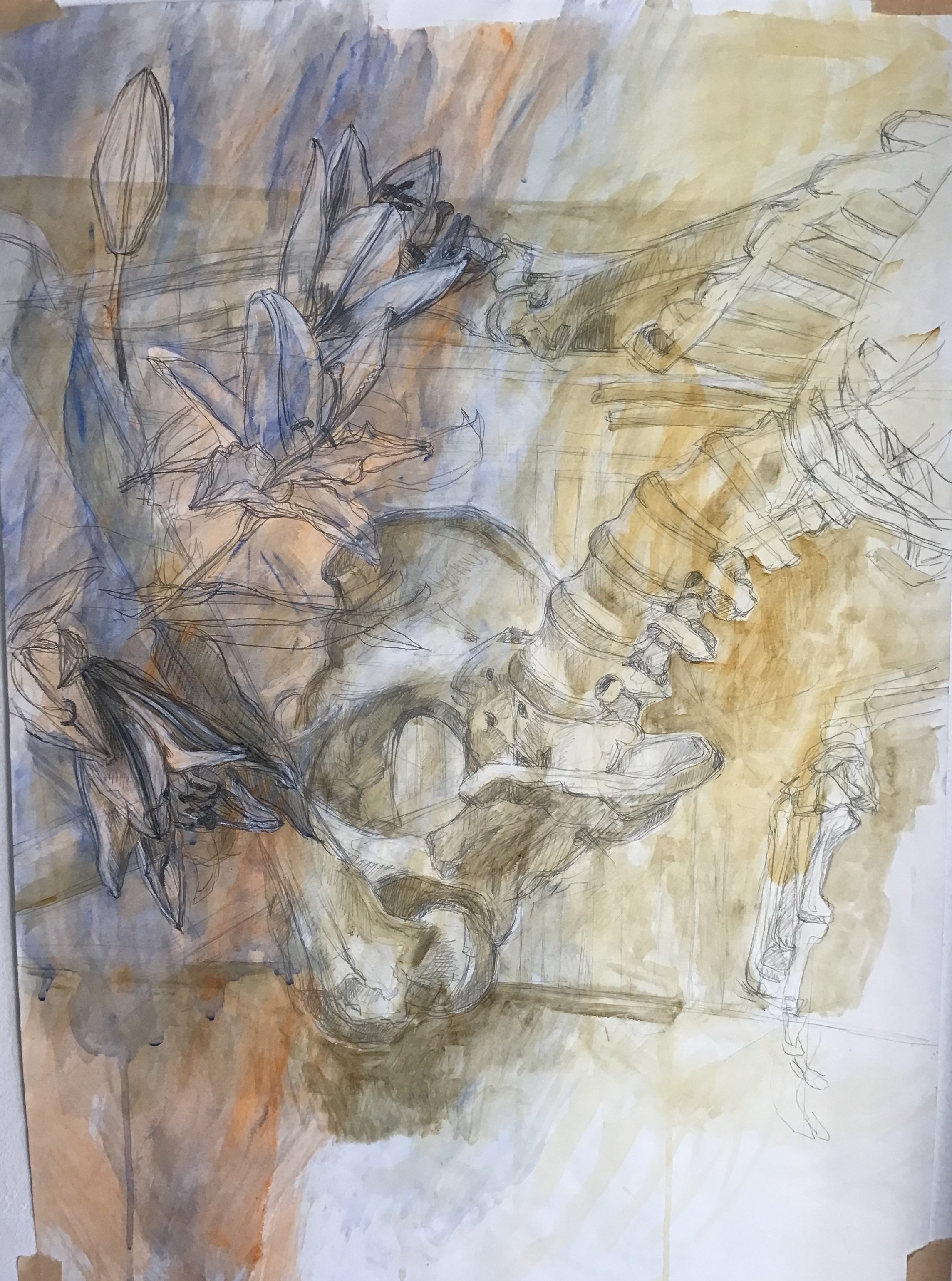
pencil (and bones) on paper 

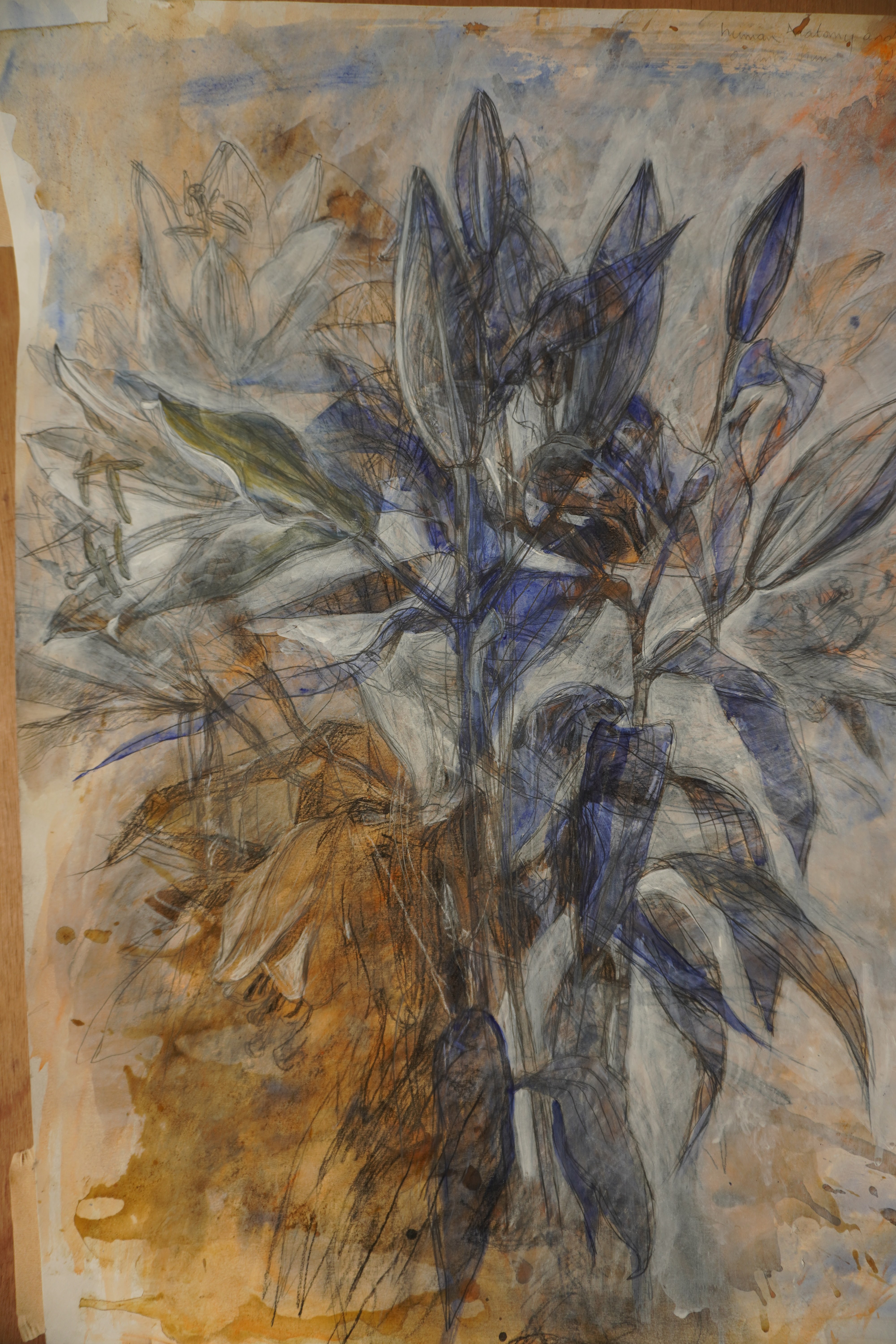
I have been drawing flowers and bones from direct observation, noticing changes in form happening in slow motion through time and space as they metamorphize from buds to blossoms, and inevitably wither, dry and fade. Paying attention to the simple reality of flowers in a vase is a study I have set myself over the summer as a meditation/art practice to explore analogies between the forms of human anatomy and plant morphology. I am also interested in architectural and spatial geometry which is present in the pictorial space with its vertical and horizontal axis.  The particular character of the lily is evident in patterns of both growth and decay, and it's signature lines of motion, defined by curves and counter curves, which it describes at each stage in a movement which begins by reaching upwards with closed buds, opening in swaying horizontals and diagonals, and then finally sinking downwards in drooping dried cocoons as it sheds petals and leaves to the ground. At each stage the forms and shapes it adopts are worthy of close attention, as they have both individual and general qualities that are very engaging. No phase is more or less beautiful or repellant than any other. Despite this it is is rare to find images of flowers that directly focus on any stage other that the blossoming phase when the scent, form, and colour are at their most alluring and magnificent. Most people, perhaps, discard the wilted blossoms without taking time to contemplate them and so miss an essential and whole understanding of the flower and it's potential meaning, which is, as it were, 'hidden' in full view. 

Pencil on paper. Phase 1


Phase 2


Phase 3


Phase 4


Bone, branch, leaf and hand 
Earth, fire, air, water
All conditioned things,
Space, time, circle squared
Turning line to point,
Nowhere is now, here,
Centre, seed, and soil,
The flower in the sun,
Deathless, blossoming
Encircling emptiness.

Poem: July 2024 Hartridge, Devon/ Brussels, Belgium  


Pencil and acrylic on paper. Phase1


 Phase  2


Pencil and acrylic on paper 


Pencil and acrylic on paper
 

The Devil's Law Case
 John Webster

[All the Flowers of the Spring]

ALL the Flowers of the Spring 
Meet to perfume our burying : 
These have but their growing prime, 
And man does flourish but his time. 
Survey our progresse from our birth,
We are set, we grow, we turne to earth. 
Courts adieu, and all delights, 
All bewitching appetites ;
Sweetest Breath, and clearest eye, 
Like perfumes goe out and dye ; 
And consequently this is done, 
As shadowes wait upon the Sunne. 
Vaine the ambition of Kings,
Who seeke by trophies and dead things, 
To leave a living name behind, 
And weave but nets to catch the wind. 


Pencil on paper 


Charcoal on paper 


'The force that through the green fuse drives the flower
Drives my green age; that blasts the roots of trees
Is my destroyer.
And I am dumb to tell the crooked rose
My youth is bent by the same wintry fever.'

Dylan Thomas 


Pencil and acrylic on paper. Phase 1


Phase 2


Phase 3


Pencil and acrylic on paper. Phase 1


Phase 2


Phase 3


Márgarét, áre you gríeving
Over Goldengrove unleaving?
Leáves like the things of man, you
With your fresh thoughts care for, can you?
Ah! ás the heart grows older
It will come to such sights colder
By and by, nor spare a sigh
Though worlds of wanwood leafmeal lie;
And yet you wíll weep and know why.
Now no matter, child, the name:
Sórrow’s spríngs áre the same.
Nor mouth had, no nor mind, expressed
What heart heard of, ghost guessed:
It ís the blight man was born for,
It is Margaret you mourn for.

Source: Gerard Manley Hopkins: Poems and Prose (Penguin Classics, 1985)


Acrylic, pencil and charcoal on paper 


Monday, August 14, 2023

objects with narratives ....


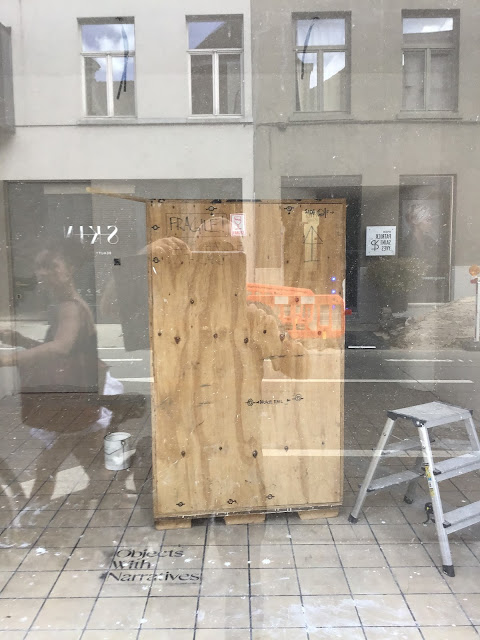
Wandering through the city the other day I photographed this shop window in a building in the middle of a major refit and renovation. It had provided someone with an impromtu pop-up 'gallery' with a 'sculptural installation' featuring a large wooden crate containing something unidentified marked 'fragile' occupying the centre of a paint besplattered floor in a space undergoing a redecoration complete with builders ladders, and loose wires still waiting to be fitted into plug sockets. Were it not for the clearly stenciled words 'objects with narratives' it would be easy to walk right past this window without taking any notice. Clearly, however, this assemblage of words and objects in such a very visible space, framed like a picture by the display window, created precisely the 'white cube' that we expect a modern gallery to be, turning anything placed in this space into something approaching an aesthetic experience, one which elicites a response or a search for meaning beyond the literal and banal nature of the objects themselves, which become, at the very least, either by accident or design, 'self-conscious' with their accompanying provocative text. 
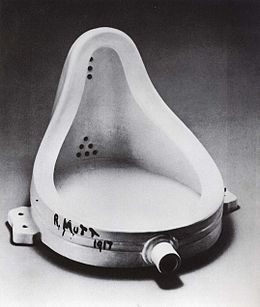

Duchamp's infamous 'Fontein' of 1917 is clearly seminal to any later potential reading of the banal and the everyday aestheticised through inclusion in a gallery, although in the case of the wooden crate the shop window was as banal as the object displayed within it, but the precedent has been set and popularized, 'ad nauseam'. 

Placing anything in a frame under glass is equivalent to placing it in a gallery. It elicits a response from the viewer who expects the image to signify, to convey meaning, either asethetic or metaphysical, something more that just registering the objects for what they are in their ordinary context.  


Photographs of Morandi's atelier in Bologna 
http://www.mambo-bologna.org/en/museomorandi/history/

In a world awash with brash and banal electronic images, the unexceptional ordinariness of the bottles, jugs, and boxes that are the quiet and self-effacing characters in the small, precise and intense relationships of Morandi' tightly composed still-life compositions would, perhaps, on the shelf of a kitchen, not be noticed. In the artist's atelier, his refuge or 'cell', they become objects of profound and obsessive contemplation. They command our attention and stand out by persisting, being patient, modest, almost self-effacing in their stillness and silence. Their muted colours and tones are natural, earthy, utilitarian and frugal but in their very 'poverty' they challenge our concepts of what constitutes 'value'. In a painting simplicity of form, space, light and colour and a sense of emptiness are sufficient for an aesthestic 'fullness'. Less is more if it heightens awareness of elemental visual qualities. 

Oil paint, like stone, confers monumentality on the ephemeral, transitory nature of the ordinary and the  banal. Fragile, inanimate, everyday objects aquire a certain dignity, even humanity, through the slow process of being observed, as the artist notices the changing light on different materials and surfaces, and it's way of describing individual forms in space though time. For the painter this creative process is itself deeply contemplative and meditative. One is dependent on focus, concentration, stillness and silence in order to become aware of and attentive to phenomena; to look at, see and even listen to the remarkable un-remarkable 'thusness' of things. One is actually 'present' to things in and through the work itself. 

John Berger had this to say about Morandi 

His pictures have the inconsequence of margin notes but they embody true observation. Light never convinces unless it has space to fill: Morandi’s subjects exist in space. However frayed, worked, muted the objects in his pictures may be, warm air surrounds them, the ground plane on which they stand comes forward, distances increase, and when one form comes to the front of another, one can calculate the exact number of inches or yards between them. His famous still-lifes of bottles have the same passive precision as his landscapes. One suspects that the bottles only contain a little water for sprinkling on the floor or eau-de-cologne for cooling the forehead—certainly nothing as strong as wine. Yet they convince—one suspends belief in the clamorous life outside the secluded room in which they stand—because of the accuracy of the contemplation that lies behind them: a contemplation so exclusive and silent that one is convinced that nothing else except Morandi’s cherished light could possibly fall on the table or shelf—not even another speck of dust.
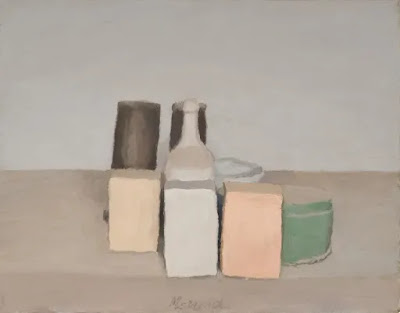

Georgio Morandi, Natura morta (Still Life), 1956, oil on canvas.

The crisis of Western art today is due to the isolation, the over-specialization and, above all, the inflated sense of individuality of the artist. Morandi’s example cannot in the least alter the truth of this, but it can remind us that there is such a thing as a genuine recluse who can still belong to—and not sabotage—the humanist tradition. I defend Morandi’s work because for an artist inhabiting an ivory tower he is remarkably humble; or, to put it another way, because he allows the same light to fall on his few precious, eccentric possessions as falls on Italy outside.

Georgio Morandi, Natura morta (Still Life), 1956, oil on canvas.

As for a recall to order, again that can only mean something if the example set derives from a new assimilation of experience. Morandi’s work derives from rejection: it is monastic.
                             
                                                         ://www.nationalgallery.org.uk/paintings/francisco-de-zurbaran-saint-francis-in-meditation-1

Berger's use of the term 'monastic' to describe Morandi's creative process recalls to mind another artist, Francesco de Zurbaran.  The subject, or motif does, of course, matter. It is no concidence that Zurbaran's wonderful painting of Saint Francis at prayer, the saint who aesthetecises poverty more than any other in the history of art, is done with such economy of colour, mostly warm and cool earthy browns or muted greys, and such dramatic effects of light and shadow to describe the qualities of a few simple, perhaps even, ironcally, sensual, surfaces; the hidden pinched flesh of face and hands, the rough textile of the habit with its frayed hole in the elbow of the sleeve, or the smooth rounded dome of the skull bone, the memento mori object of the saint's contemplation. Its frugality and artistic economy of means are both subject and metaphor. The eye is directed towards an interiority beyond outward appearances, a richer metaphysical reality below or beyond the surface of things and outside of the frame. We are directed towards what is invisible.  The painting itself is a contemplation of contemplation. 

In one sense all art is by definition, self-referencing.  It is constructed from within or in relation to the existing conventions of making and seeing.  Materials, techniques and processes carry with them cultural conditioning, traditions and an historical memory, even as they may break and remake them to speak to new experiences. Reading Colm Toibin's 'The Magician', one follows the contemporary novelist writing his novel grafted onto the biographical facts and imagined interior life and creative process of the other novelist, Thomas Mann, as he concieves and writes his novels in his historical context.  Is it indirectly a self-portrait at the same time as a portrait of his subject, weaving past, present and future into an historical researched, imaginatively re-constructed, self-aware narrative?  Like Velasquez', 'Las Meninas', a portrait of the artist making a work of art, a painting of a painting, a mirror of a mirror, a representation of representation itself. Do the patterns of history repeat themselves and is creative process itself a kind of reproduction, with works of art bearing a familial likeness to their literary or artistic forbears?   

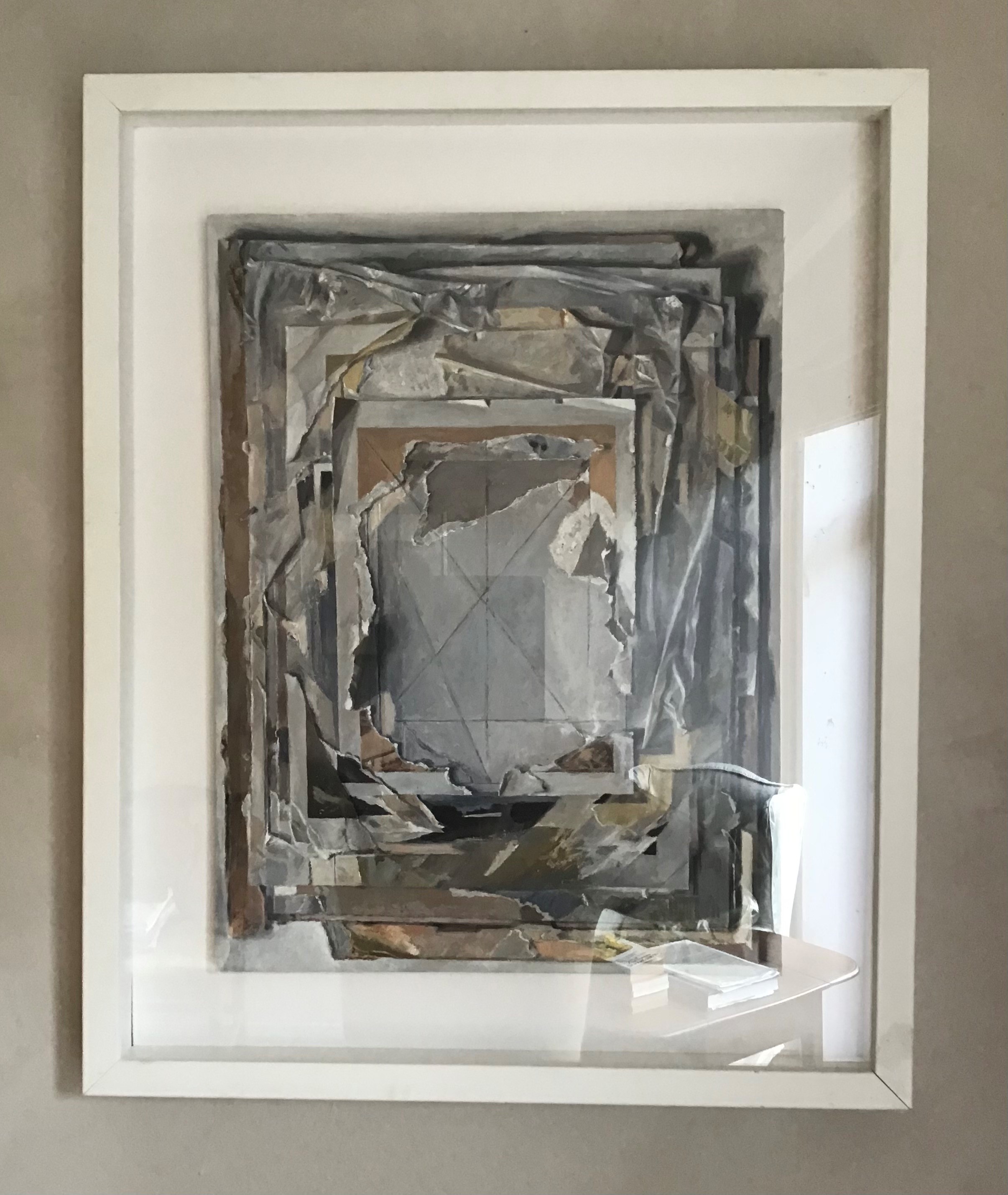
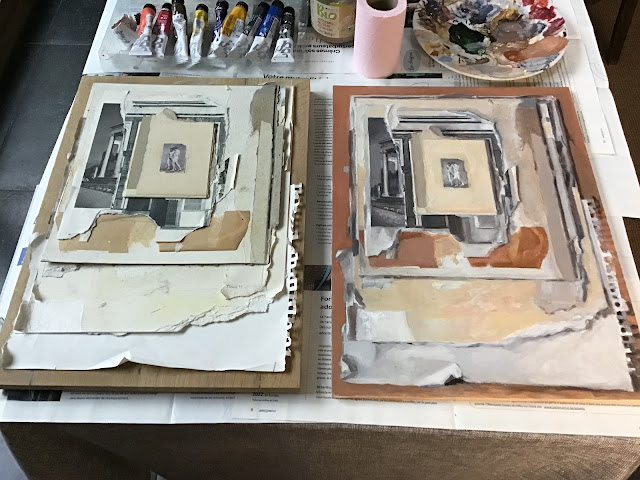
The subject of my painting below, which is a work in progress, involves fragmentary glimpses into the history if art garnered from the pages of long defunct and damaged art history books with their faded black and white illustrations. It is a representation of representation. The fragile and ephemeral nature of paper, creased, torn, and fragmented, damaged, like the art itself, by time and the inevitable process of decay. Collage is visual palimpsest, an attempt to reuse and reconfigure various fragments, to reassemble them into an new aesthetic visual order, and to find, through both accident and design, significance in certain formal relationships and abstract visual quaities which emerge because of the missing fragments and inevitable lacunas. The process of turning the collage into an oil painting in the tradition of trompe l'oeil creates a kind of 'mirror' of reality that monumentalises the more transitory, delicate paper collage into something relatively more fixed and permanent. Is this oil painting 'mimesis' the original or the copy? Are these twinned images simulacra? Are they separate and different creative works, or are they inextricably linked, connected by a process involving both loss and recouperation, reality and illusion?     


Thursday, April 13, 2023

Lacuna

 lacuna

/ləˈkjuːnə/
noun
  1. 1.
    an unfilled space; a gap.
    "the journal has filled a lacuna in Middle Eastern studies"
  2. 2.
    ANATOMY
    a cavity or depression, especially in bone


Area of consolidated losses from one of the Giotto frescos in the 
Lower Basilica of St Francis at Assisi, without any reintegration of the image. 
The 'minimalist' approach to restoration that does not disguise a visible lacuna. 

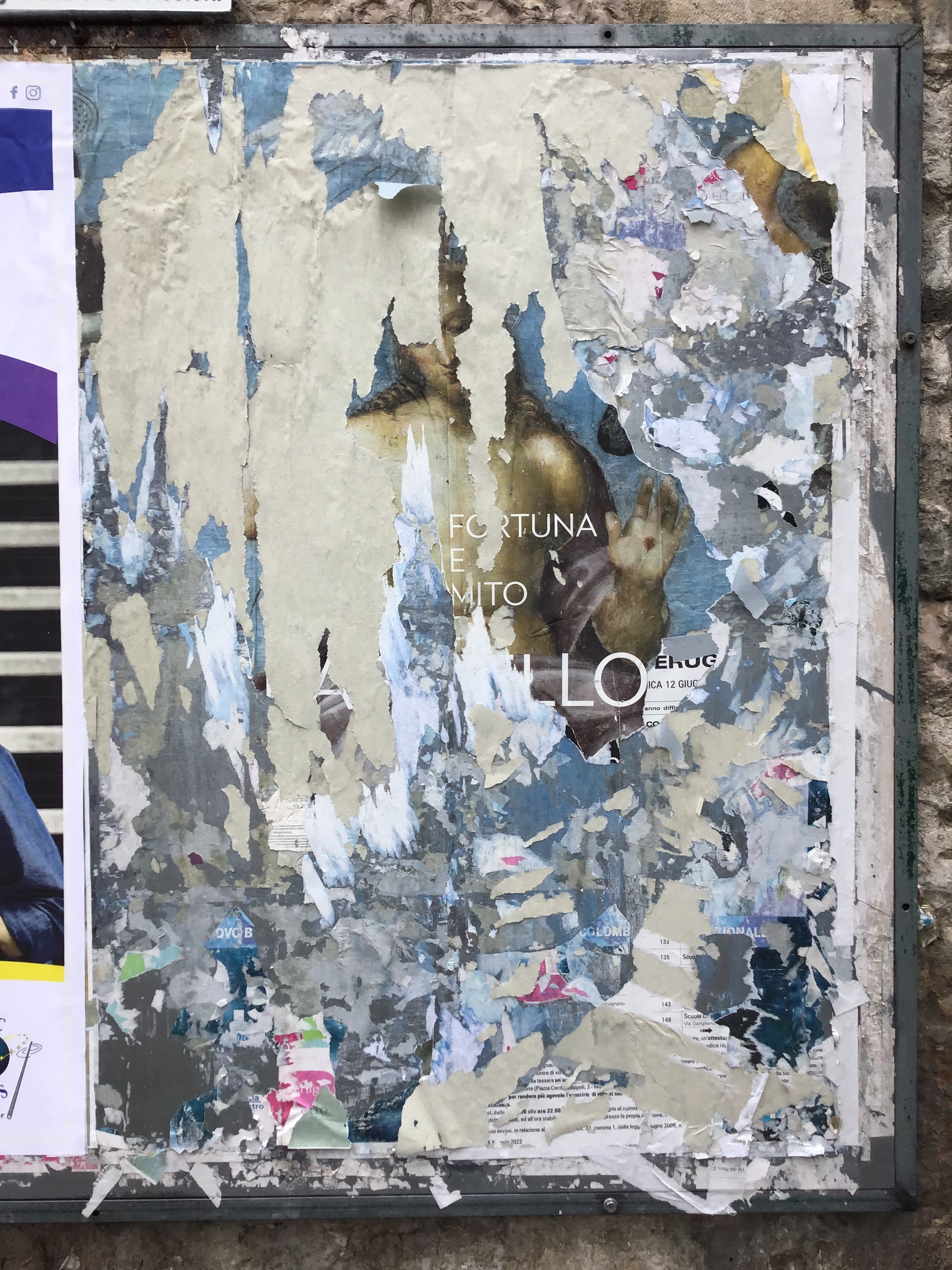
Traditional paper advertising hoarding in Perugia revealing multiple layers of
 'archeological' time through space in the shallow surface. 

In February I was in Rome, Perugia and Assisi for the spring break. I wanted to see Giotto's fresco cycle of the Life of Saint Francis in the Basilica as well as soak up some spring sunshine in Umbria. Images have miraculous agency in the legend of the life of St. Francis. It was the icon cross of San Damiano, that now hangs in Santa Chiara, which instructed him to, "repair my house, which, as you can see, is falling completely to ruin.” The restoration of buildings and images is about consolidating and strengthing, replacing missing parts and filling in gaps or lacuna. 


“The Miracle of the Crucifix,” Giotto,  Life of St. Francis cycle in the Upper Basilica of San Francesco in Assisi

 Thomas of Celano's 'Life of Saint Francis' records how the saint was devoted to his 'Lady Poverty' embracing radical poverty and simplicity over richness and complexity. It is ironic that the ostentatious and triumphalist Basilica of Saint Mary of the Angels at Porziuncola envelops the simpler tiny church that Francis knew and of which he said, after he returned one day to discover the brothers embellishing it and began to tear down what they had added,

'... that anything in that place that looked too ostentatious would immediately be heard about throughout the Order and taken as an example. And he would have destroyed the house from its very foundations if some soldiers who were present had not stopped him in his zeal by declaring the house belonged to the city and not to the brothers'  

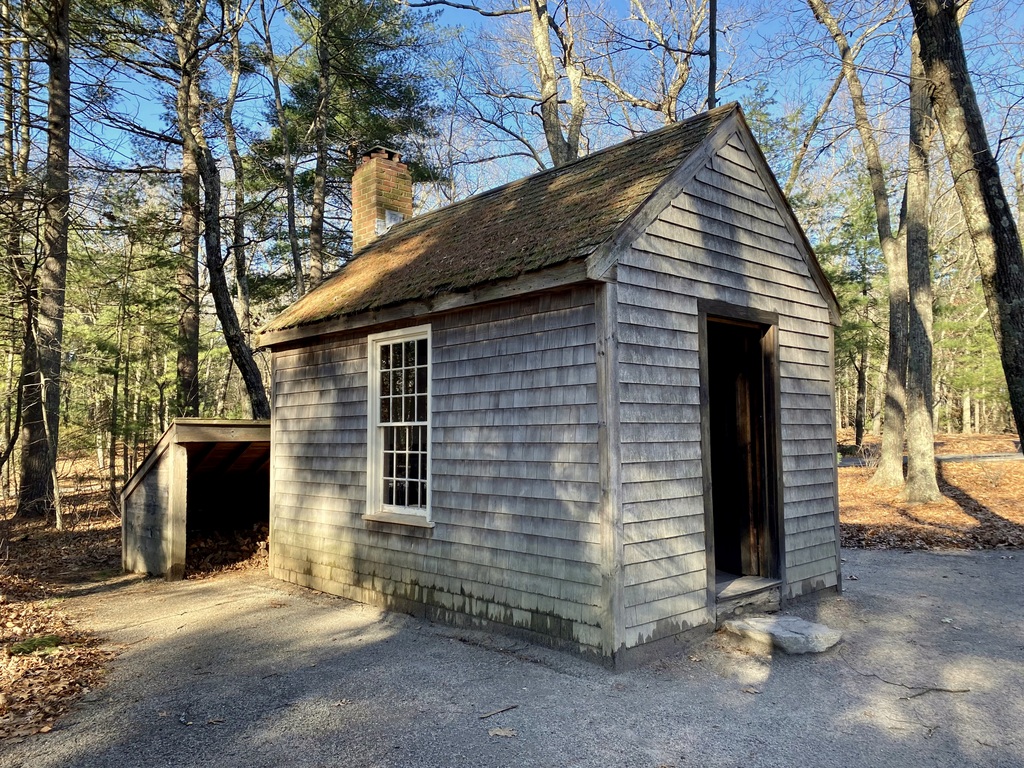
Imagine something in stone, roughly the size of Thoreau's cabin at Walden Pond, inserted like the tiniest Russian doll into the heart of the massive baroque basilica seen in section in Vignoli's drawing below, and you have some sense of the extreme visual polarity, and surreal architectural and philosophical contradiction inherent in the relationship between the diminutive and grandiose forms 

Seventeenth-century drawing of the dome (Porziuncola Museum, Vignoli 1989).


 Reconstruction of Henry David Thoreau’s cabin at Walden Pond in Concord,


Francis, like Henry David Thoreau centuries later, seems to have discovered an abundance rather than a lack in his love for poverty, and to have created an 'aesthetic' of simple sufficiency that might find a parallel in another tradition like that of Japanese wabi sabi, embodied in crafts like boro patchwork fabrics or kintsugi ceramics. 

'Wabi-sabi is the view or thought of finding beauty in every aspect of imperfection in nature. It is about the aesthetic of things in existence, that are “imperfect, impermanent, and incomplete”

Traditional boro kimono 

                         The actual patched robe of Saint Francis of Assisi which powerfully 
                            evokes his tangible bodily presence precisely because of it's absence   
                                    
In this aesthetic less can be as meaningful as more, emptiness contain as much significance as fullness, silence be as audable as sound, absence as evocative as presence, and negative space as equal in value to positive shape.  

       Empty art gallery window and wall in Knokke, Belgium, with moving shadows and reflections from the sun. 

In my own work with collage and oil painting for the 'Fugitive Images' series I was fascinated by the mystery of what is simultaneously 'something' and 'nothing', an image of 'no image, or a picture of 'no picture', a trompe l'oiel or illusion of something real which is perhaps a 'true lie' in visual terms, so to speak. Which is the 'original' and which the 'copy', since both are made by the artist as part of the same creative process and are interdependent ?  Seeing is believing, but seeing is also an act of creation, a perceptual construction and perhaps an illusion. In the mirrored reflection of light and shadowy forms, glimpst momentarily by the eye, only a fraction of these fragments are formulated into meaningful pictures and narratives in the mind of the viewer. 

Paper collage made to work from direct observation for painting below

                               Oil painting on wood panel. Trompe l' oeil paintng of the collage above.  

Giovanni Battista Cima da Conegliano. The incredulty of Saint Thomas. 
https://www.nationalgallery.org.uk/paintings/giovanni-battista-cima-da-conegliano-the-incredulity-of-saint-thomas

In 'The incredulity of Saint Thomas', with its vanishing point and interlocking geometry of circles and squares, the artist very clearly juxtaposes the figure of doubting Thomas inserting his finger into the wound made by the spear to convince himself of the reality of the risen Christ, with the truncated view of the landscape with a pathway leading to a hilltop castle or town set amidst trees against a blue sky with drifting clouds. This landscape is seen framed like a pair of matching pictures, through the two symetrically balanced arched windows in the otherwise blank wall behind the main figures. The artist seems to be inviting us to engage with the illusion of the flat surface of the painted image itself by making us question if the landscape really continues behind the wall or whether the viewer fills in the lacuna created by the blank space in his imagination, seeing in his mind's eye the completed  image of the landcape. Now you see it, now you don't. The painting and the story is about credulity and belief, about reality and what the mind constructs from the tactile, optical and perceptual operation of the senses. Even whilst the sceptical Thomas is testing the material evidence, finding proof with his senses of the veracity of the risen Christ in his tangible bodily, physical presence. 'Jesus said to him, “Have you believed because you have seen me? Blessed are those who have not seen and yet have believed.” ' John 20:29. Now I am here, now I am not. The artist also seems to be saying that seeing in this picture is not necessarily believing, since appearance and reality are not always the same thing. Reality and illusion are inextricably linked through the lacuna. Is he warning us to 'mind the gap' between the way things are and the way we think we see them? Is he asserting that doubt is concomitant on belief ? 

Point, line and circle begin the process of creating, through geometry, a superabundance of created forms 'ad infinitum' that can be returned by the same process to the point of origin that has no dimensions and is both everywhere and nowhere to be found. 
Sacred geometry can be found in the facade and rose window of the Upper Basilica of Saint Francis in Assisi. This abstract architectural structure, in medieval and early renaissance theological context, could be said to be metaphorically an 'incarnation in stone' of the 'Mystical Body of Christ', his church.  The facade 'squares the circle', bringing time and space, human and divine, absolute and conditional into unity and equlibrium, in a relationship of balance, harmony and beauty. A similar sacred geometry and spirituality is to be found in the Islamic art that Francis may have encountered in the peaceful and respective dialogue he initiated with Islam in his meeting with the Sultan of Egypt, al-Malik al-Kamiland during the 5th crusade.  Keith Critchlow has written about this sacred geometry in his book, 'Islamic Patterns' with its illuminating introduction by Seyyed Hossein Nasr. 


Quranic calligraphy issues at once from the Islamic revelation and represents the response of the soul of the Islamic peoples to the Divine Message. The points traced by the Divine Pen created at once the celestial archetype of Quranic calligraphy as well as the lines and volumes of which the cosmic order is constituted and from which issues not only natural space, but also the space of Islamic architecture. In the mystery of the Point, represented by the diacritical point under the first letter which opens the Noble Quran, namely the letter ba', 1 is to be found the principle of both Islamic calligraphy and Islamic architecture, the principle of both the sonoral and plastic arts, the root of both of which is to be found in the Sacred Book. The points and lines of Islamic calligraphy with their inexhaustible diversity of forms and rhythms are related to that Supreme Divine Precinct at whose centre resides the first Point which is none other than His Exalted Word. The Master of Illumination, Shihab al-Din Suhrawardi, begins one of his prayers with these words: 'O Master of the Supreme Circle from which issue all circles, with which terminate all lines, and from which is manifested the First Point which is Thy Exalted Word cast upon Thy Universal Form.'

Islamic Art and Spirituality. Seyyed Hossein Nasr. State University of New York Press. 


St. Francis of Assisi Receiving the Stigmata, fresco attributed to Giotto di Bondone, c. 1300; in the upper church of San Francesco, Assisi. 

It is possible to see a cosmic circularity in the cycles of time and space indicted by the sun and moon, and the square in the four elements of earth, air, fire and water, in the structure of Francis's famous 'Laudes Creaturarum'. It reflects an ancient and medieval view of the universe and acknowledges Francis's 'Altissimu, omnipotente bon Signore', whom he praises; the invisible God, whose image and likeness is 'personalised' in the incarnated Christ, (and whose crucified image Francis himself 'copies' when it is literally projected onto his body as he miraculously recieves the stimata), and who is reflected in the unity and diversity of the whole 'family' of the created universe including human, animate and inanimate forms.

The Ptolemaic universe from Andrew Borde's 
The First Book of the Introduction of Knoweledge, 1542

Ultimate reality is percieved only indirectly by the senses, like the shadows cast on the wall of the cave by sunlight falling across the real forms outside the entrance, in Plato's famous allegory. The real forms that lie outside the frame of direct vision can be apprehended by reason alone. One finds the truth by a process of elimination that points ultimately to the lacuna in our knowledge and understanding. Completing it requires all our mental faculties to 'fill in the gap'.  


                                 Giotto, Legend of St. Francis preaching to the birds. Fresco Upper Basilica

The present life of man upon earth, O king, seems to me in comparison with that time which is unknown to us, like the swift flight of a sparrow through the house wherein you sit at supper in winter, with your ealdormen and thegns, while the fire blazes in the midst, and the hall is warmed, but the wintry storms of rain or snow are raging abroad. the sparrow, flying in at one door and immediately out at another, whilst he is within, is safe from the wintry tempest; but after a short space of fair weather, he immediately vanishes out of your sight, passing from winter into winter again. So this life of man appears for a little while, but of what is to follow or what went before we know nothing at all. 

Bede's Ecclesiastical History of England, ed. by A.M. Sellar, 1907 

Thus, by means of a lacuna, the mystery of the unknowable is hidden in full view.  


Laudes Creaturarum

Original text in Umbrian dialect:

Altissimu, omnipotente bon Signore,
Tue so le laude, la gloria e l'honore et onne benedictione.

Ad Te solo, Altissimo, se konfano,
et nullu homo ène dignu te mentouare.

Laudato sie, mi Signore cum tucte le Tue creature,
spetialmente messor lo frate Sole,
lo qual è iorno, et allumini noi per lui.
Et ellu è bellu e radiante cum grande splendore:
de Te, Altissimo, porta significatione.

Laudato si, mi Signore, per sora Luna e le stelle:
in celu l'ài formate clarite et pretiose et belle.

Laudato si, mi Signore, per frate Uento
et per aere et nubilo et sereno et onne tempo,
per lo quale, a le Tue creature dài sustentamento.

Laudato si, mi Signore, per sor'Acqua,
la quale è multo utile et humile et pretiosa et casta.

Laudato si, mi Signore, per frate Focu,
per lo quale ennallumini la nocte:
ed ello è bello et iucundo et robustoso et forte.

Laudato si, mi Signore, per sora nostra matre Terra,
la quale ne sustenta et gouerna,
et produce diuersi fructi con coloriti fior et herba.

Laudato si, mi Signore, per quelli ke perdonano per lo Tuo amore
et sostengono infirmitate et tribulatione.

Beati quelli ke 'l sosterranno in pace,
ka da Te, Altissimo, sirano incoronati.

Laudato si mi Signore, per sora nostra Morte corporale,
da la quale nullu homo uiuente pò skappare:
guai a quelli ke morrano ne le peccata mortali;
beati quelli ke trouarà ne le Tue sanctissime uoluntati,
ka la morte secunda no 'l farrà male.

Laudate et benedicete mi Signore et rengratiate
e seruiteli cum grande humilitate.

Notes: so=sono, si=sii (be!), mi=mio, ka=perché, u and v are both written as u, sirano=saranno

English Translation:

Most High, all powerful, good Lord,
Yours are the praises, the glory, the honour, and all blessing.

To You alone, Most High, do they belong,
and no man is worthy to mention Your name.

Be praised, my Lord, through all your creatures,
especially through my lord Brother Sun,
who brings the day; and you give light through him.
And he is beautiful and radiant in all his splendour!
Of you, Most High, he bears the likeness.

Praised be You, my Lord, through Sister Moon and the stars,
in heaven you formed them clear and precious and beautiful.

Praised be You, my Lord, through Brother Wind,
and through the air, cloudy and serene,
and every kind of weather through which you give sustenance to Your creatures.

Praised be You, my Lord, through Sister Water,
which is very useful and humble and precious and chaste.

Praised be You, my Lord, through Brother Fire,
through whom you light the night and he is beautiful
and playful and robust and strong.

Praised be You, my Lord, through Sister Mother Earth,
who sustains us and governs us and who produces
varied fruits with coloured flowers and herbs.

Praised be You, my Lord, through those who give pardon for Your love,
and bear infirmity and tribulation.

Blessed are those who endure in peace
for by You, Most High, they shall be crowned.

Praised be You, my Lord, through our Sister Bodily Death,
from whom no living man can escape.
Woe to those who die in mortal sin.
Blessed are those who will find Your most holy will,
for the second death shall do them no harm.

Praise and bless my Lord, and give Him thanks
and serve Him with great humility.[3]


https://en.wikipedia.org/wiki/Canticle_of_the_Sun