About Mhttps://sites.google.com/view/metamorphoses-alan-mitchell/metamorphoses-alan-mitchelle

This blog was started during a half-year sabbatical from full-time art teaching at St. John's International School in 2013 to develop my painting within the context of a Masters programme, charting my developing work in progress and related interests. Since retiring from full-time art teaching in 2025 I plan to continue to make posts that chart a developing meditative practice in art and life. If you click the link in my profile you can view more work on my website.

Saturday, August 5, 2017

Anniversary Recollections.

G. E. Norman at 13 years old in 1911.


'.....If ye break faith with us who die
We shall not sleep, though poppies grow
In Flanders fields.'

Major John McCrae – 1915 - Boezinge


Kathe Kollwitz sculpture Vlaslo German Cemetery
It seemed appropriate that a week which began on Monday by raising the ghosts of the past in a road trip across West-Flanders with P. commemorating the 100 year anniversary of my great uncle George Ernest Norman's death on the 31st July 1917 at the beginning offensives of the Battle of Passchendaele in WW1, ended with a performance of Montiverdi's 'Orfeo' in Brugge as part of the MA Festival based around the theme from Dante's 'La Divina Comedia'.

'Monteverdi’s iconic opera articulates Orpheus’ attempts to soothe the keepers of Hades with his voice and his lyre. He is allowed to release his beloved Eurydice from the realm of the dead, on the one condition that he does not turn around to look at her. Leonardo García Alarcón and his musicians are the fitting performers for this story about life and death, longing and recollection.'

 http://www.mafestival.be/EN/program/MAfestival_2017/2017080420Cappella

We attended the Last Post ceremony at the Menin Gate on which he is commemorated with his name and regiment - 2nd/5th Bn. Lancashire Fusiliers. I also uploaded information and pictures to the names list at the museum in Ypres based on the paintings I made for the exhibition 'Memory and Metaphor' in which he features in two paintings, 'Ancestors' and 'Ghosts'. http://www.inflandersfields.be/en/namelist/searchname


Past and future are experienced as recollection, action and projection in the present moment, internally and externally in relationships between subject and object perceived through the senses and mind. This reflex continually creates both visible, invisible, mental, physical, real and imagined 'worlds' and 'structures' which condition future present moments. These transitory 'worlds' in time and space, infinity great and small, preserve and remember even as they discard and forget the past in ever changing cycles of growth and decay, creation and destruction, birth and death.

 F. gave me photos made by Nottingham visitors to Brugge and Ypres in 1920.

In W.G Sebald's 'Austerlitz' time is experienced in dreamlike recollections that form monologues by the main character, Austerlitz as his story is related by the almost invisible narrator in the first person. Austerlitz both remembers and reconstructs out of fragments of recollection and detective like research ( he is an art historian ) his own mysterious identity which as a Czech Jewish orphan sent into war time exile into Wales is both a personal as well as collective history.  The act of remembering, of piecing together fragments to create a meaningful narrative around personal identity in Sebald's novel is both a creative and imaginative act - like that of the novelist himself creating his fictional characters- as well as a convincing version of 'real events' reconstructed from actual experience. The book is illustrated with old photographs, rather like the ones of F's Nottingham visitors to Brugge, that punctuate the narrative and act as catalysts for creative and imaginative 'musings' as well as anchoring the text with a kind of visual evidence from the camera's apparently objective eye.  The interpretation of dreams, which are not 'real' can, like fiction in literature, provide a key which allows us to approach, deal with and understand indirectly through metaphor and allegory those things which we cannot deal with directly. This is a kind of archeology of deeply buried emotions and experiences - which is what Freud, an obsessive collector of Greek, Roman and Egyptian antiquities, compared psychoanalysis to.

Perhaps house renovation is actually a kind of a metaphor - fearlessly but thoroughly opening up, pealing back, stripping bare and revealing all the secret and damaged places, and when the symptoms of the problems have been fully understood and diagnosed, solving them.  Making everything good again by repairing and replacing and/or integrating old with new materials, strengthening and reinforcing everything, cleaning, breathing, healing, letting in light and space, neutralising harm, bringing health, warm, comfort, peace, calm.........

Removing the rotten floorboards and the thin and damaged beams in the attic floor.
Replacing them with solid reclaimed ancient oak beams.


Reusing sourced, found and excavated old stones and bricks in the courtyard to make a pavement.
The past is always a creative invention of the present but this imaginative act is constructed from the real fragments salvaged from the surviving debris. Memory and loss, desire and longing play a part in the ongoing project of self-invention and/or deconstruction of identity. Whether building up or breaking down all states, however permanent they may appear, are ultimately conditional and provisional and the boundaries between sleep and wakefulness, dreams and reality, often less rigid and defined than we think.
Self-portrait after a painting by Jan Van Scorel. oil on wood panel
Once upon a time, I, Chuang Chou, dreamt I was a butterfly, fluttering hither and thither, a veritable butterfly, enjoying itself to the full of its bent, and not knowing it was Chuang Chou. Suddenly I awoke, and came to myself, the veritable Chuang Chou. Now I do not know whether it was then I dreamt I was a butterfly, or whether I am now a butterfly dreaming I am a man. Between me and the butterfly there must be a difference. This is an instance of transformation.

Translated by James Legge, and quoted in The Three Religions of China: Lectures Delivered at Oxford (1913) by William Edward Soothill, p. 75


Wednesday, July 19, 2017

Before and After

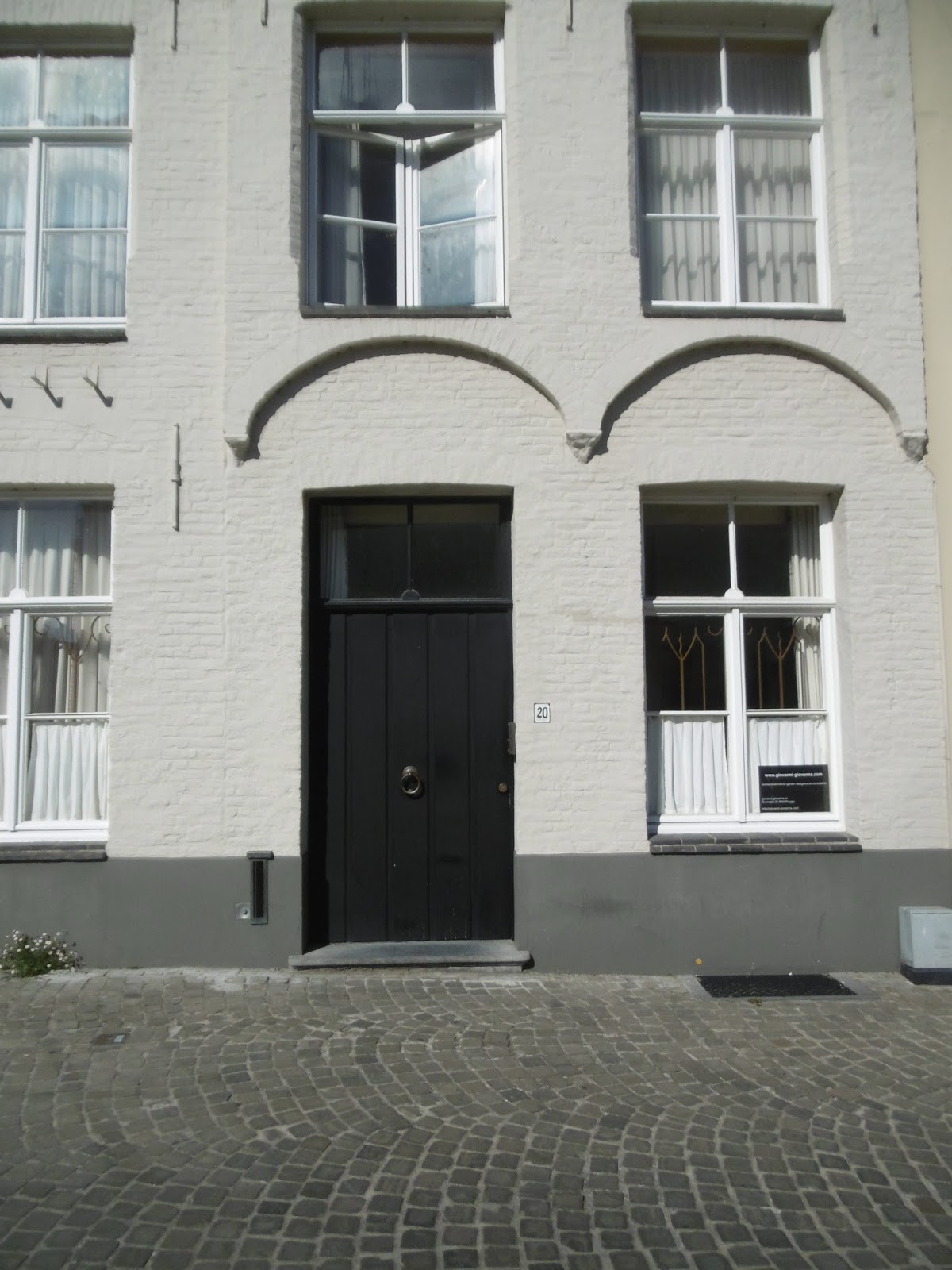
Facade windows with mastic fixed, sanded and primed and painted making the whole front look cleaner and lighter. I have yet to see if a kalean with lime paint is actually necessary or not as the brick is quite attractive in its fully restored state. 


'Someone, he added, ought to draw up a catalogue of types of buildings, listed in order of size, and it would be immediately obvious that domestic buildings of less than normal size- the little cottage in the fields, the hermitage, the lock-keeper's lodge, the pavilion for viewing the landscape, the children's bothy in the garden - are those that offer us at least a semblance of peace, whereas no one in his right mind could truthfully say that he liked a vast ediface such as the Palace of Justice on the old Gallows Hill in Brussels' 

Spoken by Austerlitz in W. G. Sebald's book of the same name


Reclaimed bricks from site sorted and cleaned ready to use for the outside courtyard floor

Sunday, July 2, 2017

Facelift at 53

20th century cement rendered facade before stripping
work begins........

Loose bricks are taken out.....
Hidden cracks appear......

Facade is washed and cleaned revealing the old bricks typical for 15th-17th cen. on the left.


Bricks are replaced and holes rebuilt with similar old bricks
Cracks are consolidated with long metal pins and strong mortar

The consolidated facade with replaced and remodeled bricks in places.

Pointing in lime mortar and replacing 20th century cement window sills with traditional terracotta tiles.

The finished brickwork awaiting the replacement of the guttering.
Working with the professional help of Aquastra and following the advice and instructions of the city department this modest facade has been finally renovated and should last for quite a few years more.  The putty in the windows has been sanded and cleaned off and where it is weak or cracked replaced and consolidated with new putty and leveled off ready for painting. If I do eventually kalean the facade in a soft broken white or cream and paint the plinth grey, or if I leave the facade as brickwork - I will need to paint the windows with a colour that will look right with either finish. I think the answer is to take inspiration from traditional solutions. Similar windows in the Beguinage in both brick and painted facades have a soft satin/matt black on the thick wood frames and white on the putty and thin glazing bars. I will do the same but use a softer,warmer dark grey instead of black,which I will use for the door. The effect will not be too different to what is there now.The pictures below give some idea of potential colour schemes.

Beguinage House
House along the Sint-Annarei


Sunday, June 11, 2017

Getting Plastered


With the sunny, dry and warmer spring weather conditions are right again for mixing lime plaster and I have been able to work on walls upstairs now that the ground floor is basically finished. Insulating  the loft and other roof spaces and plaster boarding the ceilings and partition walls is the main preoccupation inside at present. Over the summer we plan to fix the rest of the woodwork, including replacing the smaller damaged oak beams on the first floor with good reclaimed old oak and putting a new solid wood floor in the attic as well as fitting it's new window into the space that was bricked up. 


Hopefully we can also finish the walk-in wardrobe space off the main bedroom in the sloping cat-slide roof space where I have been opening up the bricked up door, the reading corner on the landing and the small bedroom. In a few days 'Aquastra' will strip, consolidate and repaint the facade with lime and when this is finished over the summer I will fix the putty on all the front windows, sand and paint them inside and out as well as tidy up and prepare the walls and ground in the small courtyard space at the back.


 The good thing is that downstairs the small fitted part of the kitchen is neatly finished in solid oak by P. to match the other fitted parts in the bathroom, hall and porch and all the tile skirting is now fixed so it is much less dusty. Now I need to fix the old brass handles which I found in the flea market to the doors and do some serious cleaning, polishing and painting to finish these spaces off.


Living in the past .....

Follower of Jan Van Scorel 1535

Self-Portrait after a follower of Jan Van Scorel 2017

I have long wanted to paint a small self portrait in the tradition of the philosophical 'vanitas' or 'memento mori' portraits of the 16th or 17th centuries. The work above is based on a small painting in the National Gallery in London which had all the key elements of the genre which I have recently begun to paint in oil on wood panel as a current work in progress. I have added a device below the hand and skull often found in Renaissance portraits by artists like Holbein, Bellini and Moroni which is a ledge and a small trompe l'oeil of folded paper on which I plan to write A. M. PINXIT. MMXII. AETATIS SVAE 53.  (which roughly translates as- A. M. painted this in 2017 in his 53rd year ) I plan to include a small flower ( not sure which yet and will have to carefully consider its symbolism) held in the left hand to contrast with the skull on which the right hand rests in the portrait.

Marking time with a backward glance at tradition in this way with a self portrait is a natural process for many painters. I particularly like Otto Dix's famous self-portrait painted in 1912 when he was a young man which evokes the early German masters. It puts me in mind of Herman Hesse's famous novel Narziss und Goldmund ( Death and The Lover) published in 1930, which charts the lives and relationships of two friends,  the monk, Narziss and the artist, Goldmund, and their ascetic and aesthetic modes of being,  in the middle ages.

Otto Dix. Self-Portrait. 1912 


 The 'self-consciousness' of these reflections in a mirror, this speculation ( from the Latin 'speculum' for mirror ) or inquiry into both the outward appearance and the inner reality of 'the self', emerges in this early modern period and is implicit in the Renaissance portrait, with its classical and humanist allusions (evident in the Roman intaglio ring in the Jan Van Scorel painting) and stoical preoccupation with beauty and death, the fragility of wealth and status and brevity and transience of life.  The same preocupations are present in Michel De Montaigne's essay, 'On Solitude' in Screech's translation below published in the Penguin Classics selection from 1993.

We have lived quite enough for others : let us live at least this tail end of life for ourselves. Let us bring our thoughts and reflections back to ourselves and our own well-being. preparing securely for our own withdrawal is no light matter: it gives us enough trouble without introducing other concerns. Since God grants us leave to make things ready for our departure, let us prepare for it; let us pack up our bags and take leave of our company in good time; let us disentangle ourselves from those violent traps which pledge us to other things and which distance us from ourselves. We must unknot those bonds and, from this day forth, love this or that but marry nothing but ourselves. That is to say, let the rest be ours, but not so glued and joined to us that it cannot be pulled off without tearing away a piece of ourselves, skin and all. The greatest thing in the world is to know how to live to yourself. 


Monday, May 1, 2017

Liefde en Dood, Eros and Thanatos

Cindy Wright – Haunted by ill angels, 2013

Last Sunday afternoon I went to the opening of 'Between Earth and Heaven II'  A tribute to Willy Van Den Bussche at the Huis  De Lombard in Langstraat in Brugge.


The range and quality of this intensely tactile work carefully curated into different rooms and spaces in the decayed splendor of this grand Herenhuis was really astonishing and powerful tensions and symbiotic relations were variously calibrated throughout between art and context, old and new, growth and decay, death and desire. Rather than a white modernist clinical 'laboratory' or a gallery that preconditions one to a certain kind of expectation of aesthetics, the empty but charged rooms of this mansion with their heavy decoration and sense of presence/absence added to the disturbing beauty of many of the works and a pervasive feeling of 'vergankelijkheid' or transience. 

Frans Gentils, ' Halewyn Service' looked particularly the part in what could have been a decadent dining room. Its chillingly contemporary demonology based on an old Dutch folk tale explores the nature of evil which resonates today with as much force as it must have done in medieval times. 


In keeping with these existential preoccupations on 21st May am planning to hear Sonia Prina and Robera Invernizzi at the Concertgebouw in Brugge singing duets by George Friederich Handel, Antonio Lotti and Claudio Monteverdi on the theme of 'Amore e Morte'. Despite non-visual non-material nature of sound it is still felt in the body with an intense physical awareness. 

On a sunny Sunday afternoon over this May weekend it was delightful to meet up again with Leon de Bliquy and Annie Vanhee. Several years ago I worked with Leon to set up student workshops and to curate an exhibition at St. John's Gallery after he was in Belgium temporarily from South Africa in an exhibition entitled 'Odyssey'. I was impressed both by his use of curious personal mythological motifs, rich, colourful tempera palette and exuberant and dynamic gestural marks. Since then Leon has settled in Ostend and his gradual loss of sight is the big change but despite this both his mind and spirit remain open and unbounded. We plan to work together on an return exhibition in St. John's Greene Gallery featuring the last works he made before the loss of sight, a series of paintings of 'jesters' with related poems in Africaans and English in the spirit of Erasmus's 'Loft de Zothied'

Ship of Fools. Leon de Bliquy


Change and uncertainty are hardwired into experiential reality. 'Ars Longa Vita Brevis' but despite this Latin saying even art itself is transient. My own last works have been as much about the nature of how images themselves decay and fall apart even as they try to arrest time and capture it for posterity. Sight and insight are connected but like Gloucester in Shakespeare's King Lear it is only when he looses his eyes that he sees clearly.

work in progress on an image of an image negated.......

'The play's the thing where in to catch the conscience of a king' Micheal Pennington as Hamlet. RSC Stratford-upon-Avon 1980

I was surprised to find this mural I painted on the wall of my room in school when I was 16 years old, photographed and posted on the internet after 37 years on a site dedicated to decayed buildings.


Sunday, March 12, 2017

Mystical Contrasts


A couple of weeks ago I heard Hildagard Von Bingen's haunting 11th century chants performed alongside music by the 20th century Russian composer Galina Ustvolskaya. The contrasts in texture and tone between the human voice and the various solo instruments, which included a piano, tuba, cello, clarinet, flute and violin couldn't have been greater and yet Het Collectief and the singers of Psallentes wove a seamless fabric of sound that was riveting from beginning to end with an electrifying inner intensity made even greater by the intimate nature of the performance with the audience seated in unnumbered seats around the stage in front of the musicians.

Have been reading the revelations of another medieval mystic, Julian of Norwich, whose 'showings' with their vivid visualizations of the suffering Christ and simple, powerful images of the loving and forgiving Divine Motherhood of God remind us that the medieval world and mind was intensely tactile and visual, suffused with allegorical interpretations of ordinary things which could ( and can?) unlock deep and startling insights into the extraordinary.

  "Our Savior is our true Mother in whom we are endlessly born and out of whom we shall never come.” 

“And in this he showed me a little thing, the quantity of a hazel nut, lying in the palm of my hand, as it seemed. And it was as round as any ball. I looked upon it with the eye of my understanding, and thought, ‘What may this be?’ And it was answered generally thus, ‘It is all that is made.’ I marveled how it might last, for I thought it might suddenly have fallen to nothing for littleness. And I was answered in my understanding: It lasts and ever shall, for God loves it. And so have all things their beginning by the love of God."


In the house the ground floor is gradually coming to completion with the tiles which I made in Malta over 20 years ago  finally set in place in the fireplace and the contrast between various sorts of ever changing natural and artificial light, as the spring comes and the days lengthen, beginning to define the evolving nooks and crannies.  In the house during the 'crocus vacanzie' I modeled a lime plaster niche in the hall which creates an opportunity for traditional candle light and atmospheric shadows in this small dark corner and  elsewhere in the hall P. had the bright idea of inserting a thin strip of led light into the thickness of the plate and plasterboard ceiling in the hall skylight.  The first layer of lime paint in a neutral natural colour is being applied and this also helps to absorb and diffuse light in a different way.


 I also managed to find some brass handles and key holes for the doors at the Place Jeu du Balle market in Brussels.