About Mhttps://sites.google.com/view/metamorphoses-alan-mitchell/metamorphoses-alan-mitchelle

This blog was started during a half-year sabbatical from full-time art teaching at St. John's International School in 2013 to develop my painting within the context of a Masters programme, charting my developing work in progress and related interests. Since retiring from full-time art teaching in 2025 I plan to continue to make posts that chart a developing meditative practice in art and life. If you click the link in my profile you can view more work on my website.

Tuesday, November 11, 2014

Of chimneys and gable ends...


'But a man has no more to do with the style of architecture of his house than a tortoise with that of its shell.......... 

...........What of architectural beauty I now see, I know has gradually grown from within outward, out of the necessities and character of the indweller, who is the only builder - out of some unconscious truthfulness, and nobleness, without ever a thought for the appearance and whatever additional beauty of this kind is destined to be produced will be preceded by the unconscious beauty of life. 

Henry Thoreau  'Walden' 
fragments of text discovered attached to the
underside of the joists and floorboards.  

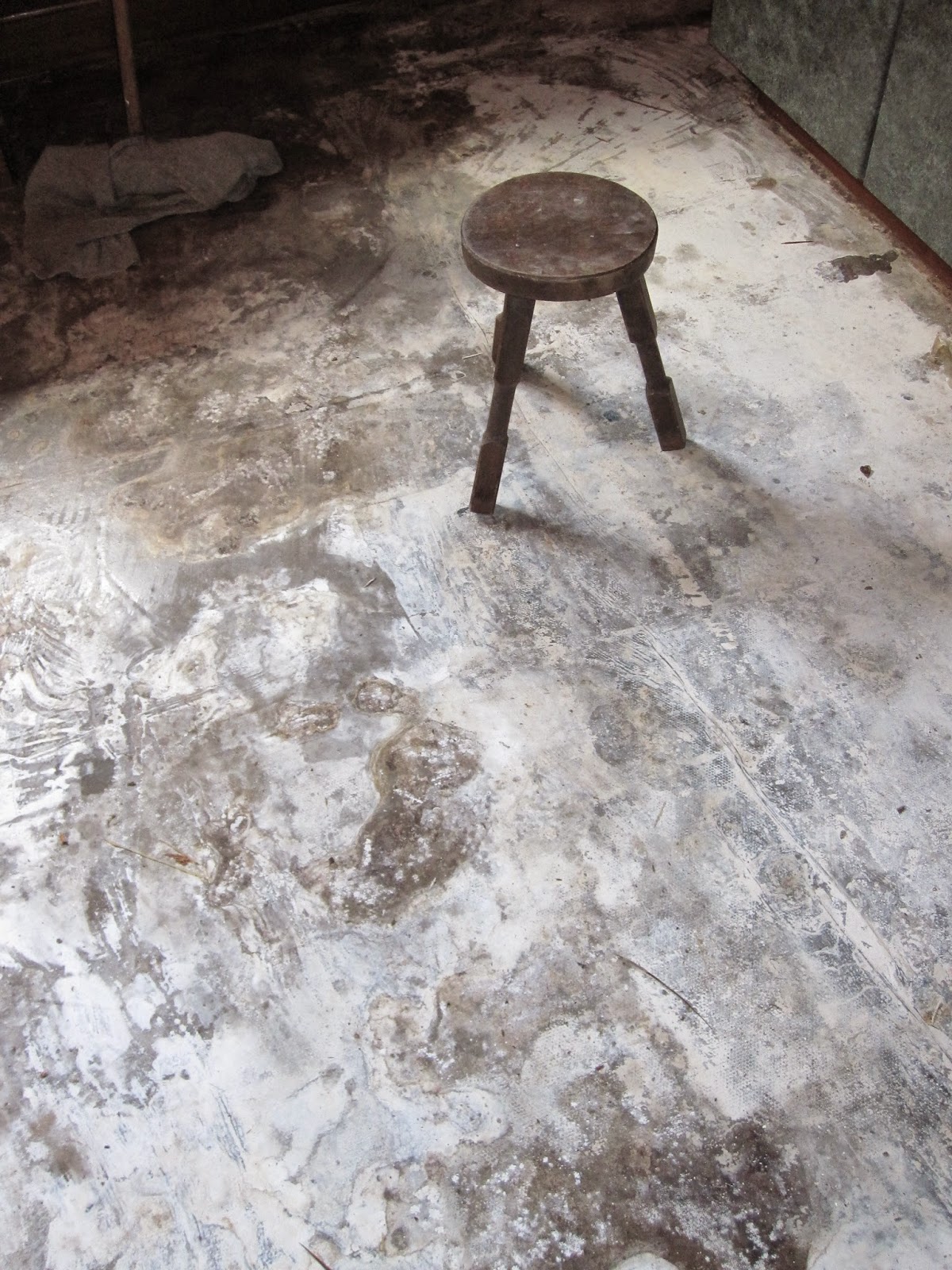
The October break gave me a chance to really begin to strip back the layers of wallpaper, board, vinyl and plastics that seem to have stifled and suffocated the structure of the house over the years. It is strange but it feels rather like being inside a three dimensional version of one of my paintings, peeling back layers of time packed with dust and memories long since discarded and forgotten 

Emblemata 6.
Egg tempera, Indian ink acrylic and silver-point on wood 25x33cm. 
Partially stripped wall in the house.

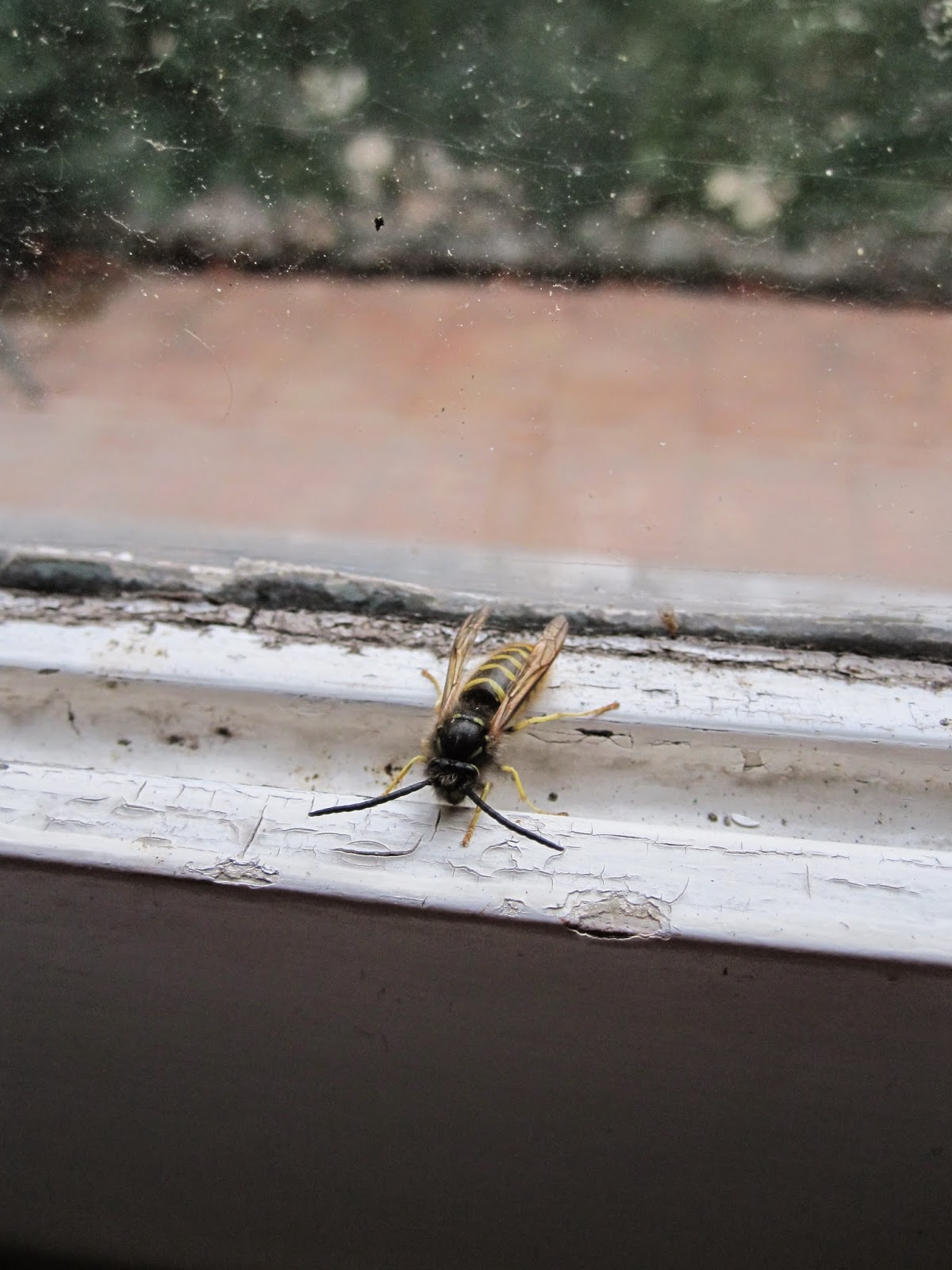
In getting to know the character of the place I have encountered other significant occupants in addition to my human neighbours. The man from the brandweer assured me that the wasps from the nest in the roof who have been gathering in significant numbers on the kitchen window were sleepy and likely die now that winter was coming and the best thing I could do would be to release them - which I did - about thirty or so individually by knocking them gently into a small wicker tea strainer and then tapping them out onto the window sill in the terrace outside from where they could fly off to the freedom of an uncertain future. 
Above a wasp in the kitchen before being released 
and below a fragment of one of several long since 
abandoned nests discovered in the ceilings

I discovered a mummified mouse behind the tongue and groove cladding which I am removing in the living room. Goodness knows what I will discover when I start to dig the trench for the septic tank and drainage...


Of all my neighbours however the most significant are the great horse chestnut tree and its companion beech tree in the garden adjacent which shelter the gable end of the house shedding between them a vast quantity of leaves, beechnuts and horse chestnuts which clog up the guttering and have to be continually swept. 

The Beech Tree
The Horse Chestnut Tree
Apart from the voices of tourists and the clatter of wheeled cases on the cobbles the sound of birds and bells adds significantly to the sense of both place and space especially in the morning when I open the door to the terrace and look up. 


Reading 'Walden' during a lunch break ........
Reconstruction of Thoreau's cabin at Walden Pond, Massachusetts from a visit I made a few years ago.  


Sunday, October 26, 2014

Squaring the Circle in London

Olafur Eliasson - Colour Experiment No #57 
Black Square 1915
Kazimir Malevich
Back from the High School London Art Trip two images stay firmly fixed in my mind, Olafur Eliasson's colour experiments based on the palettes of Turner's late paintings in the Tate Britain exhibition, 'Painting Set Free'.  Exploring the spectrum of colour and light in a traditional format these large minimalist paintings recall for me the elemental shape of the neophrite 'jade' disks of neolithic China. The jade Bi disk is thought to represent 'heaven' whist it accompanying square 'Cong' corresponds to earth, a parallel perhaps to the symbolism in Western antiquity and the geometry of Renaissance Italy explained  in Alberti's 'De re Aedificatoria'. The atmospheric light and colours of Turner great skies, often based on carefully calibrated layers of subtle nuanced complementary colours, are clearly evoked in this circular form and referenced in the smooth transitions colour.    


I bought the catalogue of an earlier exhibition by Ines Richter-Musso and Ortrud Westheider which took place in Hamburg, Krakow and Margate between 2011-2012 called, 'Turner and the Elements'. It does seem that although Turner's paintings are clearly situated in specific historic times and places relative to and conditioned by his life and journeys he is actually concerned with the timeless motion of the elements, earth, air, fire and water and their ever changing cycles of creation and destruction and how this is also a part of the creative and imaginative life of the artist and his feelings and perceptions in relation to his own interior and the exterior phenomena of nature, and the nature of the medium of expression. 

Malevich's radical and iconic 'Black Square' of 1915 which I saw at the Tate Modern is surely the great grand mother of Rothko's Black Paintings of the 1960's which I recall seeing with students on another London art trip at the Tate in 2008.  Conjuring both light and darkness, space and form simultaneously they appear to be both solid form and empty void. Are they a window into deep space perceived through muted light or a wall of opaque dark matter ? 

Mark Rothko No 7 1964


Tuesday, October 14, 2014

Flesh and Stone


The title of this post alludes to Richard Sennett's book of the same name which explores 'The Body and the City in Western Civilization' 

Have managed to prepare a white gesso ground on eight new MDF squares 5x300x300mm ready to paint on and will begin soon.


Back from the first weekend of wall scraping in Bruges.I felt like Howard Carter in Tutankhamun's Tomb when I uncovered the 16th century oak spine beams still in rock solid condition


There does seem to be a strange 'symbiosis' between both of these projects - building up and stripping back layers accumulated over time on different surfaces

Looking forward to seeing 'Sense and Sensuality. Rubens and his Legacy' at the Bozar over the October break in between bouts of wall scraping. 


Ruben's, like Lucien Freud, a more recent figurative painter in the same tradition, makes the analogy between the oleaginous nature of 'skin' on the painted surface of the canvas and human flesh.  Despite the counter reformation iconographic rhetoric the real subject in his explosive overblown compositions is the existential drama of human flesh - its birth, growth, maturity and ageing, death and decay - and the power of the painted image to outlive its transient fleshy subject matter. 


'The Death of Seneca' Peter Paul Rubens. c1615

Lucian Freud, Painter Working, Reflection, 1993.


Pursuing these analogies further from previous posts between bodies of paint and flesh and flesh and stone in houses and cities it is interesting to see how the various states of growth and decay, destruction, renovation and restoration have occurred in cycles in this old building and the rest of the city. The marks of time have a certain honesty and beauty about them if we can look with a degree of equanimity and without too much desire or aversion at both our own bodies and the bodies of wood, stone, ceramics, paint and plaster that form the outer protective 'skin' we call home.

It will be some time before these surfaces have lime plaster, beeswax and terracotta on them and various nuanced shades of white paint and the natural colour of stone, wood and raw linen to soothe the eye and gladden the heart...........but in the mean time they are a suitable subject for practical meditation in the spirit of the Upajjhatthana Sutta and its five recollections that should be reflected upon frequently 


1.I am sure to become old; I cannot avoid ageing.
Jarādhammomhi jaraṃ anatīto....
2.I am sure to become ill; I cannot avoid illness.
Vyādhidhammomhi vyādhiṃ anatīto....
3.I am sure to die; I cannot avoid death.
Maraṇadhammomhi maraṇaṃ anatīto....
4.I must be separated and parted from all that is dear and beloved to me.
Sabbehi me piyehi manāpehi nānābhāvo vinābhāvo....
5.I am the owner of my actions, heir of my actions, actions are the womb (from which I have sprung), actions are my relations, actions are my protection. Whatever actions I do, good or bad, of these I shall become their heir.
Kammassakomhi kammadāyādo kammayoni kammabandhū kammapaṭisaraṇo yaṃ kammaṃ karissāmi kalyāṇaṃ vā pāpakaṃ vā tassa dāyādo bhavissāmī.

Sunday, September 21, 2014

Alchemy in words, images, stone and paper.


A couple of weeks ago I visited the calligraphy collection of Jan Broes in the house 'De Zomere' in Oude Zomerstraat, Brugge, which Marguerite Youcenar decided would be the house of her fictional hero, the physician/philosopher/alchemist Zeno in her book 'The Abyss,' set during the Renaissance in Flanders. 


The four elements, earth, air, fire and water are present in both obvious and subtle ways in the various parts of the house from the threshhold of the door to the windows, alcoves, fireplaces and the pond in the courtyard. 


The calligraphy which can be found in several significant locations around the house on stone, paper and other materials, often appears in conjunction with the recurring motif of a carved labyrinth. The whole house has a quality of charged significance. 


Encounters with mundane everyday spaces and things are potential moments of metamorphoses, as the ordinary is transformed into the extraordinary. Like the alchemist's quest for the philosopher's stone,  base metal becomes gold and relative time aligns with the absolute.   Ciphers and symbols provide keys to unlock a parallel universe 'hidden' in full view in the domestic space. 


There is a very Flemish sense of enclosed spaces, with windows leading to both inner and outer worlds and visions; immanent and transcendence, sacred and profane.  


The medieval mind, described by Umberto Eco in his book 'Art and Beauty in the Middle Ages', saw and read the most ordinary things with loaded metaphysical significance. Those who look closely and try to decipher the meanings encoded in early Flemish paintings, like Robert Campin's 'Merode Altarpiece', will find the same ordinary domestic world full of theological and supernatural significance, framed by solid perspective of doors and windows, both painted and real, hinged to the frame of actual triptych itself which opens and closes to both hide and reveal its message like the angel in this annunciation. 
   

Here are some more pictures from 'De Zomere'


Yesterday whilst waiting for the builder I visited the paper maker Piet Moerman

www.papierschepperij.be

.....and took these photos of him making paper by hand in his workshop in Greinschuurstraat.  


One way to save paper is to value it - in a world of disposable Xerox handmade paper is something you keep for life......

Musical and visual composition - the sound of colours and shapes ?


The St John's 50th Anniversary golden wall and ceramic tile installation made with students explores the synthesis between the circle and the square, organic and geometric shapes, light and colour and the tactile and visual qualities of 'gold leaf'. 

This light hearted playfulness with the possibilities of the square 'frame' and grid continues to preoccupy me in class with various student projects and some of my own experiments. 

Continued to work on the series of geometric abstractions for F. and ended up with a cycle of six small paintings that seem to form a sequence and constitute a kind of hommage to Kazimir Malevich -appropriate perhaps as we are planning to visit the exhibition at Tate Modern on the London Art Trip in October. As I continue to develop this work I hope to be able to freely explore the colour spectrum and its various subtleties as well as the 'musical' relationships between various abstract elements of shape and form in space within each composition.


Sunday, September 7, 2014

Mapping Sound in Time and Musical Form in Space

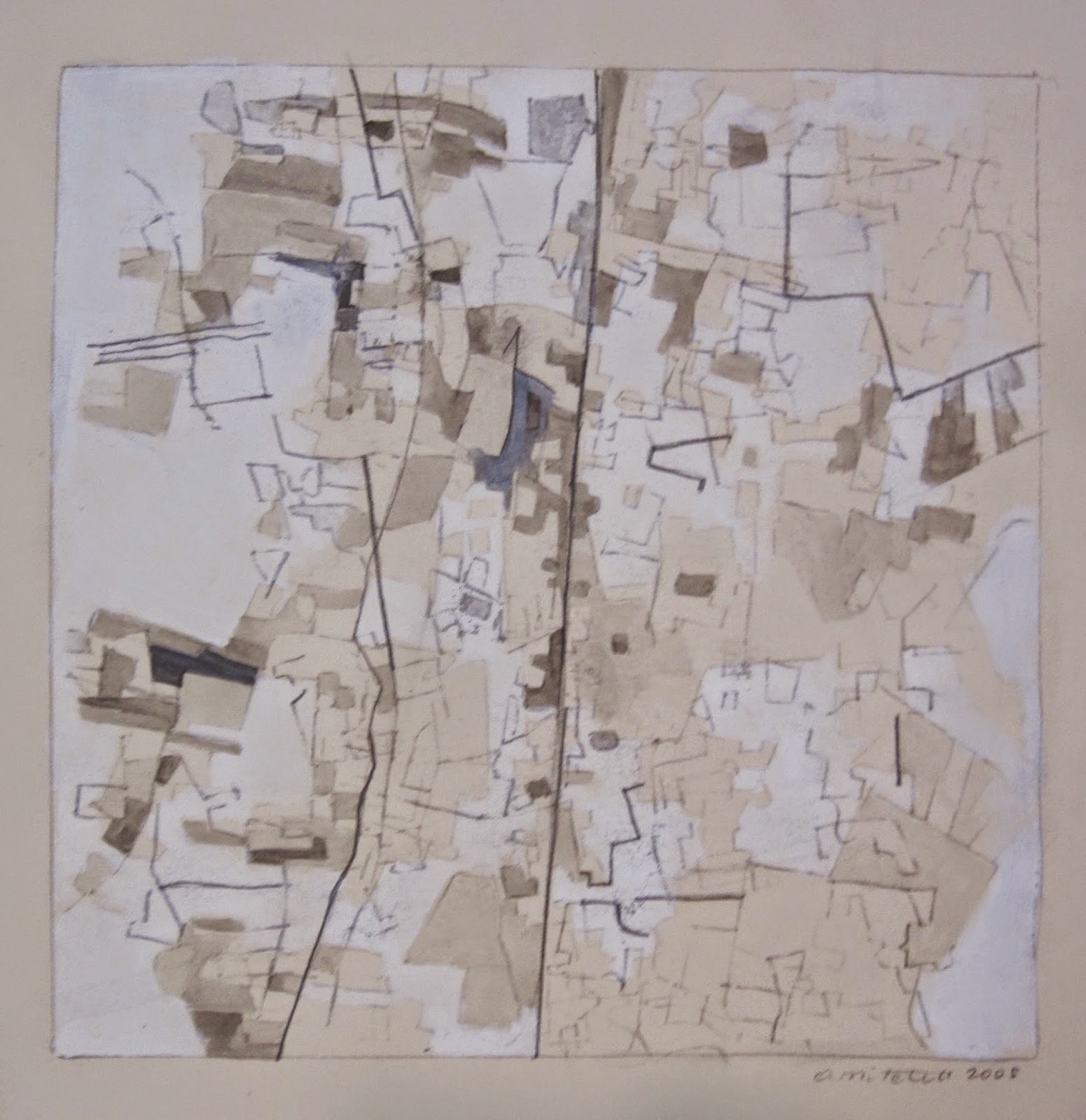
I have started some experimental new work for F. based on a series of drawings I made some time ago  called 'mappings'. These were concerned with lines and shapes inspired by the patterns of fields on maps and archeological drawings, with overlapping, transparency and superimposition used to create depth. I plan to develop a series of geometric abstractions in layers of paint, applied using masking tape, that will explore a limited range within the colour spectrum focusing on complementary relationships and using colour and tone to create, balance, contrast, space and depth. 


The results of initial experiments (illustrated above) have, it seems, been influenced by another project I am working on this year in class with students called 'Drawing Sounds'. This is designed to explore the suggested relationships between the compositional structures and expressive sounds of music, existing in the dimension of time, and the various marks of different media used in drawing with visual elements like gestural lines, patterns, rhythms, shapes and colour etc which exist in the dimension of space. The project is based a programme of suggested works that pianist Kaoru Tashiro will play in a concert in school in January 2015, hopefully with some of the student's drawings projected in a stop motion animation.  We will explore the importance of music in the work of Kandinsky and Paul Klee as well as the idea of a language of pure abstraction and reference Klee's 'Pedagogical Sketchbook', Kandinsky's, 'Point and Line to Plane' and 'Sounds'.  


Saturday, August 30, 2014

Dwellings. Wood and Stone, Mountain and Tree.....

The triangular 'roof' of the mountain, the apex of which seems to be the focus of its 'breathing',  like the point of the nose in Anapanasati meditation. The circulation of air and water condenses and evaporates in clouds, freezes in snow and ice and then melts into streams and waterfalls flowing into rivers that empty into the lakes..........
Walking in the Italian Alps and the English Lakes over the summer we naturally encountered many mountains and trees as well as islands and lakes whose triangular and circular geometry seemed to  align with the 'squared circle' or fourfold cycle of the seasons and the endless motion of elements, earth, air, wind, and fire constantly changing everything in time and space.


                         The little world of the Isola di San Giulio whose single road silently encircles its monastery 
                              like a small world or cosmos isolated and framed by the surrounding water of the lake.


                                                 Rings of smooth polished coloured pebbles created on the beach
                                       in Evia in Greece a few years ago 

New tree emerging from the dead ring of an old stump along the River Kent at Levens 
In addition to Gaston Bachelard's 'Poetics of Space' I have been reading Francis Pryor's book 'Seahenge' with its fascinating descriptions of his career in archeology and his insights into the civilisation of Neolithic Britain prior to the Roman conquest. 

I am struck by his connection between the shape of the round house with its circle of post holes to support the roof structure, the passage entrance, the door lintels and central square hearth and the shape of the stone circles or henges which are found throughout Britain and Europe. 

He has suggested that the shape of the stone circles is derived from the form of abandoned roundhouses whose remaining structures in decay became monumentalised in stone in part as an act of reverence to the ancestors who formally dwelled there. The houses of the dead therefore resembled the form of the houses of the living and the shape of the cosmos that could be observed all around them. There is a significant resemblance between for instance the Neolithic houses of Skara Brae and Maeshowe chambered cairn or tomb

Neolithic round house post holes plan and reconstruction 

Swinside Stone Circle,  Lake District. 

He says this,

'A circle is a simple, satisfying, all-encompassing shape that is straightforward to lay out on the ground'. 

He goes on to quote Professor Richard Bradley who says in his book 'The significance of Monuments: On shaping of Human Experience in Neolithic and Bronze Age Europe' 

'The idea of a circular or spherical cosmos....can carry an enormous weight of symbolism, it may originate in the experience of an individual inhabiting an increasingly open landscape. He or she is at the centre of the world which recedes towards the horizon, where the land meets the sky ... whatever their ultimate meaning, circular constructions reflect perception of space that extends outwards from the individual and upwards to the sky. The main fixed points on the land may be natural features like hills, while those in the sky are the sun and the moon, whose positions can be seen to change in relation to such landmarks. This may be why circular constructions are often subdivided according to the cardinal points of the compass, or why they often stand for a cycle in the human or natural worlds.'

Houses can clearly stand in symbolic relation to the cosmos as Paul Oliver suggests in his book 'Dwellings' citing examples like the Mongolian Yurt, The Navajo Hogan and the Tukanoan 'malocca' or community houses, saying,

'Through the myths and legends, ritual lore, epic songs and religious customs of a society, its values may be transmitted, communicated, repeated and learned. As the roof under which so much of this is acted and re-enacted in the daily, yearly and life cycles, the dwelling readily becomes the symbolic model of the greater universe of time and space in which they seem to exist'

The house in addition to representing the cosmos might also represent the body. 

In his book 'English Houses 1300-1800 Vernacular Architecture, Social Life', Matthew Johnson adapts an illustration from Robert Blair St. George's book, 'Conversing by Signs: Poetics of Implication in Colonial New England Culture', which represents the house as a structure whose 'anatomy' corresponds to that of the human body, the rafters and beams corresponding to the bones, the heart to the hearth, the eyes to the windows, the chimney to the breast and so on........


From a Buddhist point of view, like the residents of a house, 'we' only temporarily occupy the ever changing aggregates we cling to as a permanent 'self ' (form, feelings, perceptions, mental formations and consciousness) 

As I begin the process of restoring an old house that was here long before I came along and will remain long after I am gone, it seems that the work of stripping back, repairing, salvaging and recycling the solid fabric of the building is really ultimately about framing the inner and outer worlds which are experienced through the body/mind and senses - light, colour, time and space - all the intangibles.......

The path to dwelling in well being here and now may be eight-fold and the ultimate refuge threefold.

13th century Kadampa Stupa 


Brush and Ink on paper